Adult CPR Steps for Immediate Emergency Response
CPR is for someone who is unresponsive and not breathing, or only gasping. The American Red Cross explains that it helps save a life when the heart stops beating or beats too ineffectively to circulate blood to vital organs (American Red Cross, CPR Steps, read October 9, 2026). This guide sets out the Red Cross adult steps, explains hands-only CPR for people who are not trained in rescue breathing, and covers when to use an AED and how to get trained. It is a reminder, not a substitute for a class: practicing on a manikin with an instructor is what makes the steps automatic under stress.
What Are the Step-by-Step Instructions for Adult CPR?
These steps follow the American Red Cross adult CPR guidance:
- Check the scene for safety, form an initial impression, and use personal protective equipment if you have it.
- Check the person. If they appear unresponsive, check for responsiveness, breathing, life-threatening bleeding or other life-threatening conditions using "shout-tap-shout".
- Call 9-1-1. If the person does not respond and is not breathing or only gasping, call 9-1-1 and get an AED and other equipment, or tell someone to do so. Put the phone on speaker; the dispatcher can guide you.
- Position the person on their back on a firm, flat surface and kneel beside them.
- Give 30 chest compressions. Place two hands centered on the chest, shoulders directly over your hands, elbows locked. Push at least 2 inches deep at a rate of 100 to 120 compressions per minute, and let the chest return to its normal position after each compression.
- Give 2 breaths. Open the airway past a neutral position using the head-tilt/chin-lift technique, pinch the nose shut, take a normal breath and make a complete seal over the person's mouth. Each breath should last about 1 second and make the chest rise; let the air out before the next breath. If the first breath does not make the chest rise, retilt the head and check the seal before the second. If the second breath does not make the chest rise, an object may be blocking the airway.
- Continue sets of 30 compressions and 2 breaths. Use an AED as soon as one is available, and keep interruptions to compressions to less than 10 seconds.
The Red Cross also notes that when checking for breathing, you should take no more than 10 seconds.
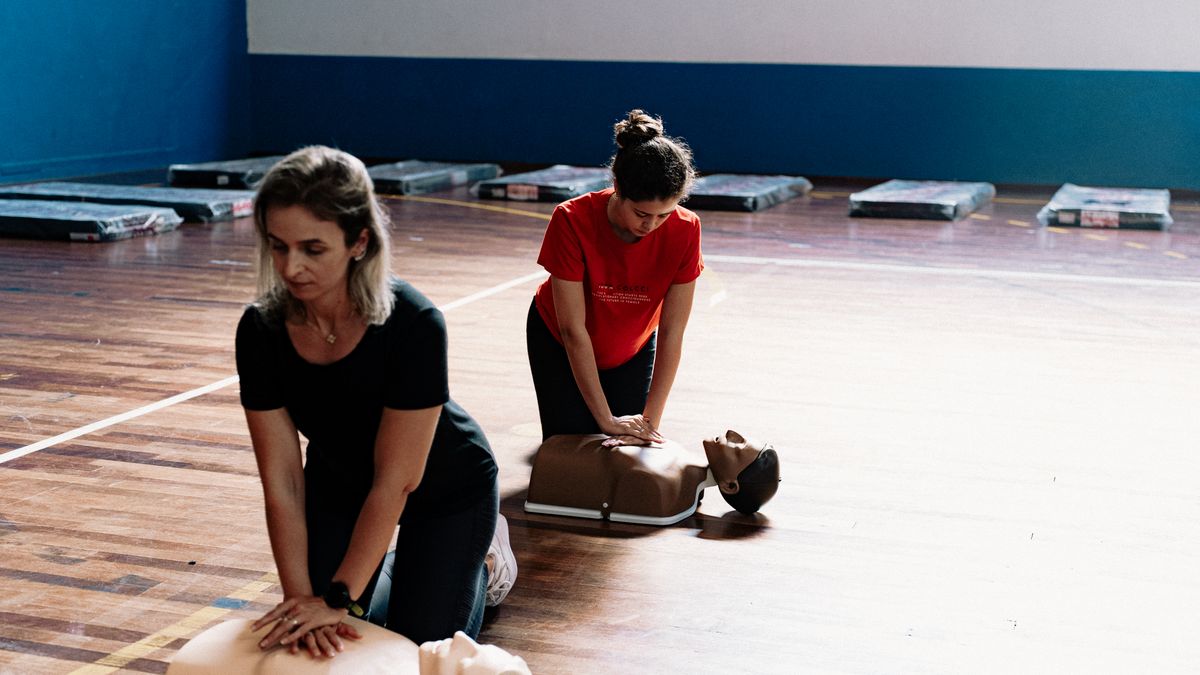
Hands-Only CPR
If you are not trained in full CPR, the Red Cross describes hands-only CPR, which is CPR without rescue breaths, as simple to learn and easy to remember, and says it increases the likelihood of surviving cardiac arrest (American Red Cross, Hands-Only CPR). Call 9-1-1, then push hard and fast in the center of the chest without stopping until help or an AED arrives. Many people keep the rhythm by pushing to the beat of a familiar fast song. Doing something is far better than doing nothing.
When Should an AED Be Used?
An automated external defibrillator (AED) analyzes the heart rhythm and, if needed, delivers a shock. The Red Cross guidance is to use one as soon as it is available. Turn it on and follow the spoken prompts: expose the chest, attach the pads as shown in the pictures on them, make sure no one is touching the person while it analyzes or shocks, and resume compressions right away when it tells you to. AEDs are designed for untrained bystanders, and many workplaces, airports, gyms and schools have one; look for the sign near entrances or elevators.
What Equipment Helps?
- A phone to call 9-1-1, on speaker so your hands are free.
- A CPR face shield or pocket mask for rescue breaths, often included in first aid kits.
- Disposable gloves as basic personal protective equipment.
- An AED, where available. Know where the nearest one is at your workplace, school or gym.
How Do You Get Trained, and How Much Does It Cost?
CPR classes are offered by the American Red Cross, the American Heart Association, hospitals, community centers, fire departments and some employers, in classroom, online-plus-skills-session and blended formats. Prices depend on the provider, the course level (for example, adult CPR/AED versus courses that add first aid or child and infant CPR) and your area, so compare current prices on the providers' class search pages. Some employers and community groups offer classes free or reimburse the cost. Online-only courses do not include a hands-on skills check; if you need certification for a job, confirm which format your employer accepts.
The Red Cross states that its CPR certification lasts 2 years after you successfully complete training (American Red Cross, CPR Certification). Refreshing skills between classes, for example with a short online review, helps because CPR skills fade without practice.
Comparison: Full CPR vs Hands-Only CPR
| Feature | Full CPR (compressions + breaths) | Hands-only CPR |
|---|---|---|
| Who it is for | People trained in CPR | Bystanders not trained in full CPR |
| Steps | Cycles of 30 compressions and 2 breaths | Continuous chest compressions |
| Compression rate and depth | 100–120 per minute, at least 2 inches | Push hard and fast in the center of the chest |
| AED | Use as soon as available | Use as soon as available |
Common Mistakes to Avoid
- Delaying the 9-1-1 call. Call or have someone call first.
- Compressions that are too shallow or too slow, or leaning on the chest so it cannot rise again.
- Long pauses. Keep interruptions under 10 seconds.
- Waiting to use an AED. Turn it on as soon as it arrives.
- Stopping too early. Continue until emergency responders take over, an AED tells you to stop, the person shows signs of life, or the scene becomes unsafe.
How deep should chest compressions be for an adult?
At least 2 inches, according to the American Red Cross adult CPR steps.
What is the correct compression rate per minute for adult CPR?
100 to 120 compressions per minute, in sets of 30 when giving rescue breaths.
Should you perform hands-only CPR or conventional CPR?
If you are trained and willing, give compressions and breaths. If you are not trained in full CPR, the Red Cross describes hands-only CPR as an option that increases the likelihood of surviving cardiac arrest.
How long is an adult CPR certification valid?
Red Cross CPR certification lasts 2 years after you complete training. Other providers set their own periods; check your certificate.
What is the first step when encountering an unresponsive adult?
Check that the scene is safe, then check the person for responsiveness and breathing. If they do not respond and are not breathing or only gasping, call 9-1-1.
When should an AED be used during adult resuscitation?
As soon as one is available. Turn it on and follow its prompts, keeping interruptions to compressions short.
Key Takeaways
- Check the scene, check the person, call 9-1-1.
- Push at least 2 inches deep at 100 to 120 compressions per minute, letting the chest rise.
- Give 30 compressions and 2 breaths if trained; otherwise do hands-only CPR.
- Use an AED as soon as one is available and keep pauses under 10 seconds.
- Take a hands-on class; Red Cross certification lasts 2 years.
Sources and References
- American Red Cross, CPR Steps — adult steps, compression depth and rate, breaths, AED, 10-second limits (read October 9, 2026).
- American Red Cross, Hands-Only CPR (read October 9, 2026).
- American Red Cross, CPR Certification — certification lasts 2 years (read October 9, 2026).