The Short Answer
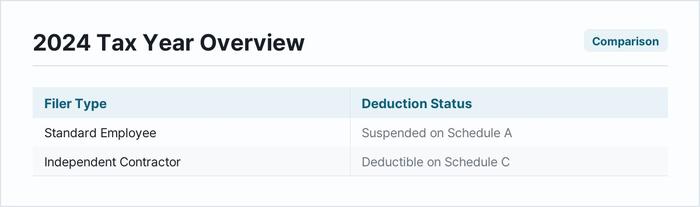
For most W-2 employees, union initiation fees and dues are not deductible on Schedule A for current tax years, because the federal deduction for unreimbursed employee expenses is no longer available to most workers. IRS Publication 529 explains that you can no longer claim any miscellaneous itemized deductions that were subject to the 2%-of-adjusted-gross-income limitation, including unreimbursed employee expenses, unless you fall into one of a few specific employment categories (IRS, Publication 529, Miscellaneous Deductions). Union dues and initiation fees used to fall into that miscellaneous category. Self-employed people are treated differently, and some states have their own rules. This guide explains who can still deduct union fees, how, and what records to keep.
This is general information, not tax advice. Rules change; check the instructions for the tax year you are filing or ask a tax professional.
Why the Federal Deduction Went Away for Employees
Before 2018, employees could deduct union dues and initiation fees as unreimbursed employee expenses — part of the miscellaneous itemized deductions that counted only to the extent they exceeded a percentage of AGI. Federal tax legislation suspended that category beginning in 2018, and Publication 529 now states plainly that these deductions can no longer be claimed, other than for the exceptions below. Later legislation changed the original end date of the suspension, so do not assume the deduction has come back; check the current Form 1040 and Schedule A instructions for the year you are filing.
Who Can Still Deduct Employee Expenses

Publication 529 lists the categories of employment that can still deduct certain unreimbursed employee business expenses:
- Armed Forces reservists.
- Qualified performing artists.
- Fee-basis state or local government officials.
- Employees with impairment-related work expenses.
It also mentions separate rules for eligible educators. If you fall into one of these groups, read the publication and the relevant form instructions to see whether union fees connected to that work qualify and where they are reported. For everyone else who works as an employee, union fees are generally a personal, non-deductible cost at the federal level.
Self-Employed Workers and Independent Contractors
If you are self-employed and pay union dues or initiation fees as part of operating your business — for example, as an independent contractor in a trade — those costs may be deductible as ordinary and necessary business expenses on Schedule C rather than on Schedule A. Business expense deductions reduce your business income directly and do not depend on itemizing. Keep the union payments tied to the business: if you have both W-2 and self-employment income in the same field, ask a tax professional how to treat fees that relate to both.
Publication 529 also notes a limit that applies regardless of employment type: you cannot deduct the portion of dues used for lobbying or political activities. Unions often tell members what share of dues went to those activities.
State Income Tax Returns
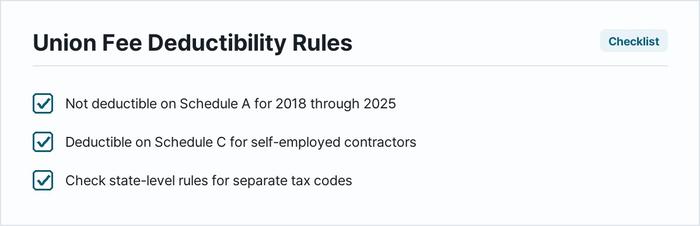
States are not required to follow federal itemized-deduction rules. Some states let residents itemize deductions differently from the federal return, and a few have allowed unreimbursed employee expenses or specific deductions for union dues. Others follow the federal rules closely. Because state laws change, check your state tax agency's current instructions or software before claiming union fees on a state return.
Other Ways Union Costs Can Matter at Tax Time
- Employer reimbursement: if your employer reimburses union-related costs under an accountable plan, the reimbursement is generally not income, and you cannot also deduct the cost.
- Voluntary unemployment funds: Publication 529 states you cannot deduct voluntary unemployment benefit fund contributions to a union fund or a private fund, though contributions required by state law to a state fund may be deductible as taxes.
- Credits and payroll: union fees do not affect payroll tax withholding on your wages; they come out of after-tax pay unless a specific arrangement says otherwise.
Records to Keep
Whether or not you can deduct fees this year, keep receipts or bank records of initiation fees and dues, any annual dues statement from your local, and any notice about the share used for lobbying. Self-employed workers should keep these with their business records. If rules change or you move to a state with different treatment, the records will be ready.
Who Can Deduct Union Fees at a Glance
| Situation | Federal treatment | Where reported |
|---|---|---|
| W-2 employee, not in an exception category | Generally not deductible | Not reported |
| Armed Forces reservist, qualified performing artist, fee-basis official, impairment-related expenses | May be deductible under Publication 529 rules | See form instructions |
| Self-employed in the trade | May be deductible as a business expense | Schedule C |
| Portion of dues used for lobbying | Not deductible | Not reported |
| State return | Depends on state law | State forms |
A Short History Helps Explain the Confusion
Many older articles, tax guides and even union handbooks still describe union dues as deductible, because for decades they were — as a miscellaneous itemized deduction for employees. Those sources were written before the 2018 change and have not been updated. When you read advice about union dues, check the date and whether it reflects the current version of Publication 529. Tax software asks about employee expenses only if you indicate you are in one of the qualifying categories, which is another sign the general deduction is no longer available.
What to Do if You Already Claimed the Deduction
If you deducted union dues on a recent federal return while not in an eligible category, the deduction may be disallowed. You can file an amended return to correct it, which may limit interest and penalties compared with waiting for an IRS notice. A tax professional can review the returns involved and advise on next steps.
Planning Around the Rule
Because the federal benefit is gone for most employees, some workers ask whether their union or employer offers ways to reduce the cost, such as payment plans for initiation fees. Others who do occasional self-employed work in their trade keep careful records so that any business-related union costs can be claimed on Schedule C. In every case, the starting point is the same: know which category you fall into for the year you are filing.
Frequently Asked Questions
Can I deduct union dues if I itemize?
For most employees, no. Publication 529 says miscellaneous itemized deductions that were subject to the 2%-of-AGI limit, including unreimbursed employee expenses, can no longer be claimed.
Are initiation fees treated differently from monthly dues?
For federal purposes, both were employee expenses and are treated the same way under the current rules.
I'm a freelance musician and a union member. Can I deduct dues?
If you are self-employed, dues tied to your business may be deductible on Schedule C. If you are an employee, check whether you meet the qualified performing artist rules in Publication 529.
Will the deduction return?
Do not assume it will. Check the Schedule A instructions for the year you are filing.
Key Takeaways
- Most W-2 employees cannot deduct union initiation fees or dues on Schedule A.
- A few employment categories and self-employed workers have different rules.
- The lobbying portion of dues is never deductible.
- State rules vary; check your state's current instructions.
Sources and References
- Internal Revenue Service, Publication 529, Miscellaneous Deductions (read October 9, 2026).
Disclaimer
This article is general information, not financial, tax or legal advice. Rules, rates and eligibility change and depend on where a reader lives and on their own situation. Figures here are illustrative; confirm current terms with the provider or agency involved, and consult a licensed professional before acting on a decision that carries real money.