The Short Answer
Private preschool tuition is not a tax deduction, but it can count toward the federal Child and Dependent Care Credit — and toward a dependent care FSA — when you pay it so that you (and your spouse, if filing jointly) can work or look for work. IRS Publication 503 states that expenses for a child in nursery school, preschool or similar programs below the level of kindergarten are expenses for care, while expenses to attend kindergarten or a higher grade are not (IRS, Publication 503 (2025)). This guide explains who qualifies, how the credit is calculated, how it interacts with employer dependent care benefits, and what records you need.
This is general information, not tax advice. Figures below are for tax year 2025 as published in Publication 503; check the current edition for later years.
Who Qualifies
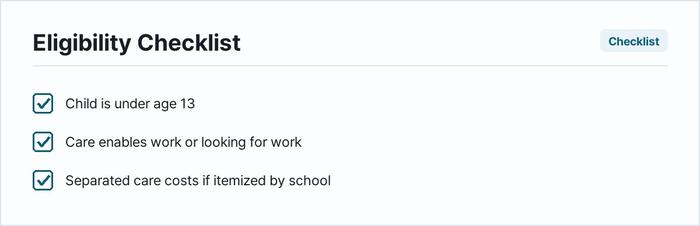
IRS Topic 602 says you may be able to claim the credit if you paid expenses for the care of a qualifying individual to enable you, and your spouse if filing jointly, to work or actively look for work; married people filing separately generally cannot claim it (IRS, Topic No. 602). A qualifying individual includes your dependent child who was under age 13 when the care was provided. You must have earned income, and you must identify the care provider on your return.
What Preschool Costs Count

- Preschool and nursery school tuition for a child below kindergarten counts as care, according to Publication 503.
- Incidental meals and activities: Publication 503's example of a nursery school that provides lunch and a few educational activities as part of care says the total cost can be counted when those items cannot be separated from the cost of care.
- Agency fees, deposits and application fees you must pay to get care count as work-related expenses, but a forfeited deposit for care you did not use does not.
- Before- and after-school care for a child in kindergarten or higher can count, even though kindergarten tuition itself does not.
Publication 503 states that care expenses do not include amounts paid for food, lodging, clothing, education and entertainment except small incidental amounts that cannot be separated from the cost of care.
How the Credit Is Calculated
Publication 503 explains that the credit is a percentage of your work-related expenses, subject to the earned income limit and a dollar limit. IRS Topic 602 states that the expenses used to figure the credit may not be more than $3,000 for one qualifying individual or $6,000 for two or more. Publication 503 says the credit can be up to 35% of expenses, with the percentage based on adjusted gross income; its 2025 table applies 35% when AGI is up to $15,000 and steps down as income rises, reaching 20% for higher incomes.
A worked example with made-up numbers: a family with one child in preschool, two working parents and preschool costs above the expense limit could count up to the $3,000 limit, and the credit would be that amount multiplied by the percentage for their AGI. Tax software or Form 2441 walks through the calculation.
Dependent Care FSAs and Employer Benefits
Many employers offer a dependent care assistance program, often called a dependent care FSA, which lets you pay care costs with pre-tax salary. Publication 503 states that for 2025 the maximum that can be excluded from an employee's income through such a program is $5,000 ($2,500 if married filing separately). You cannot use the same dollars for both the FSA and the credit: Publication 503 explains that amounts excluded or deducted as dependent care benefits reduce the dollar limit available for the credit. Families often compare the payroll-tax and income-tax savings of the FSA with the value of the credit at their income level.
Paying a Relative or Nanny
Care does not have to be at a preschool. Topic 602 notes it can be in or outside your home. But the provider cannot be your spouse, the child's parent, your child under age 19, or anyone you can claim as a dependent. If you pay a household employee such as a nanny, household employment tax rules may apply.
Records and Reporting
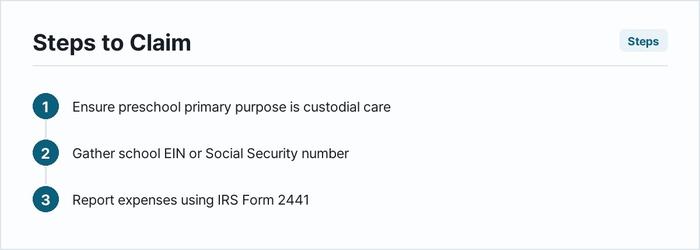
- Get the preschool's name, address and taxpayer identification number; Topic 602 says you must report these on your return (a tax-exempt organization need only give its name and address).
- Keep invoices and proof of payment, separating care from any non-incidental education or other charges.
- Claim the credit on Form 2441 attached to your Form 1040; if you received employer dependent care benefits, complete Part III of that form.
- Count only expenses paid in the year; Publication 503 says expenses incurred in one year but paid in the next are claimed in the year paid.
Source: IRS Topic 602, Child and Dependent Care Credit, as cited in this article.
State Credits
Many states offer their own child or dependent care credits, sometimes calculated as a share of the federal credit. Eligibility, income limits and refundability vary. Check your state tax agency's current instructions.
At a Glance (Tax Year 2025, IRS Publication 503)
| Item | Rule |
|---|---|
| Preschool or nursery school below kindergarten | Counts as care |
| Kindergarten tuition | Does not count |
| Before- or after-school care | Can count |
| Expense limit | $3,000 for one child, $6,000 for two or more |
| Credit percentage | Up to 35%, lower as AGI rises |
| Employer dependent care exclusion | Up to $5,000 ($2,500 married filing separately) |
Common Mistakes
- Counting kindergarten or private school tuition, which Publication 503 excludes.
- Using the same expenses for both a dependent care FSA and the credit.
- Leaving out the provider's identification number, which can delay or reduce the credit.
- Claiming costs while one spouse was not working or looking for work, unless an exception applies.
Frequently Asked Questions
Can I deduct preschool tuition as an education expense?
No. Preschool costs are not deductible, but they can count toward the Child and Dependent Care Credit if the care lets you work.
Does kindergarten qualify?
Not for tuition. Publication 503 says kindergarten and higher grades are not expenses for care, though before- and after-school care can be.
What if only one parent works?
Generally both spouses must work or look for work, with exceptions in Publication 503 for a spouse who was a full-time student or unable to care for themselves.
Can I use both an FSA and the credit?
Yes, but not for the same dollars; FSA amounts reduce the expense limit for the credit.
Key Takeaways
- Preschool tuition can count toward the Child and Dependent Care Credit, not as a deduction.
- Kindergarten tuition does not count; before- and after-school care can.
- Expense limits and percentages are set in Publication 503 for each year.
- Coordinate a dependent care FSA with the credit and keep the provider's details.
Sources and References
- Internal Revenue Service, Publication 503 (2025), Child and Dependent Care Expenses — preschool counts as care; up to 35%; 35% at AGI up to $15,000; $5,000 dependent care exclusion (read October 9, 2026).
- IRS, Topic No. 602, Child and Dependent Care Credit — $3,000 / $6,000 expense limits (page last reviewed September 24, 2026; read October 9, 2026).
Disclaimer
This article is general information, not financial, tax or legal advice. Rules, rates and eligibility change and depend on where a reader lives and on their own situation. Figures here are illustrative; confirm current terms with the provider or agency involved, and consult a licensed professional before acting on a decision that carries real money.