The Short Answer
Yes. Nonprescription allergy medicines — antihistamine tablets, steroid nasal sprays, allergy eye drops and similar products — can be paid for with a health savings account (HSA) or a health flexible spending arrangement (FSA) without a prescription. IRS Publication 969 states that expenses incurred for over-the-counter medicine, whether or not prescribed, are considered medical care and are a covered expense (IRS, Publication 969 (2025)). That rule took effect after a 2020 change in law; before it, most over-the-counter medicines needed a prescription to be reimbursed. This guide explains how the rules work for each account, how to pay or get reimbursed, what records to keep, and the limits and deadlines that matter.
This is general information, not tax advice. Your plan's own rules and your employer's administrator have the final word on what an FSA reimburses.
What Counts as an Eligible Allergy Purchase
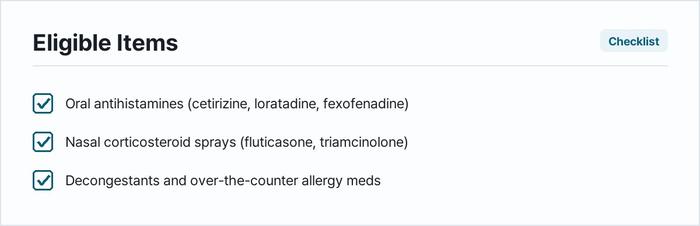
Because the IRS treats over-the-counter medicine as medical care, the usual allergy products qualify:
- Oral antihistamines (for example, loratadine, cetirizine, fexofenadine and diphenhydramine).
- Steroid and antihistamine nasal sprays.
- Allergy eye drops.
- Decongestants and combination allergy-sinus products.
Items that are not medicine — such as air purifiers, special bedding or vacuum filters — follow different rules. They are generally treated as medical expenses only when they are primarily for a medical condition, which often means a letter of medical necessity from a provider. Ask your plan administrator before buying.
Using an HSA

An HSA belongs to you and is paired with a high-deductible health plan. Publication 969 explains that distributions used for qualified medical expenses are tax-free, while money withdrawn for other purposes is subject to income tax and may be subject to an additional 20% tax. For 2026, Publication 969 lists HSA contribution limits of $4,400 for self-only coverage and $8,750 for family coverage, with an extra $1,000 allowed if you are 55 or older. Unused HSA money carries over from year to year.
You can pay with the HSA debit card at checkout, or pay out of pocket and reimburse yourself later from the HSA. Publication 969 says you do not have to make withdrawals each year, so keeping receipts and reimbursing yourself later is allowed as long as the expense was incurred after the HSA was established.
Using a Health FSA
A health FSA is offered through an employer and funded by pre-tax salary reductions. Publication 969 describes qualified expenses as those specified in the plan that would generally qualify for the medical expense deduction, and repeats that over-the-counter medicine is a covered expense. For 2025, Publication 969 cites Revenue Procedure 2024-40: a salary-reduction limit of $3,300 and, if the plan allows carryovers, a maximum carryover of $660. Check your plan documents for the current year's figures.
FSAs are generally "use-it-or-lose-it." Publication 969 explains that a plan may offer either a grace period of up to 2½ months after the plan year or a carryover of unused amounts, but not a refund of the balance. Allergy medicine you would buy anyway is a common, sensible way to use up a remaining balance before a deadline.
How to Pay or Get Reimbursed
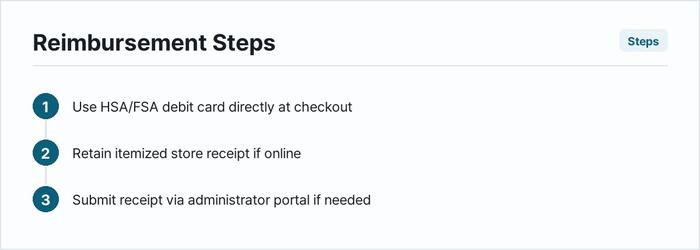
- At the register: many pharmacies and large retailers flag eligible items automatically when you pay with an HSA or FSA card. If the card is declined for an item you believe qualifies, pay another way and file a claim.
- Online: some retailers accept HSA and FSA cards; others do not. Keep the itemized order confirmation.
- Manual claims: submit an itemized receipt showing the store, date, product name and amount to your plan administrator, usually through an app or website.
- Self-reimbursement from an HSA: withdraw the amount from your HSA and keep the receipt with your records.
Publication 969 notes that employer-issued debit, credit and stored-value cards can be used for health FSA reimbursements, and that if card use meets certain substantiation methods you may not have to provide more information. Your administrator may still ask for a receipt, so keep them.
Records to Keep
- Itemized receipts showing the product name, not just a total.
- For HSAs, a simple log of which expenses you reimbursed and when.
- Any letter of medical necessity for items that are not medicines.
The IRS can ask you to show that HSA distributions paid for qualified medical expenses, so the burden of keeping records is on you.
Can You Also Deduct Allergy Medicine on Your Tax Return?
Generally no. IRS Publication 502, which covers the itemized medical expense deduction, says that except for insulin you cannot include in medical expenses amounts you pay for a drug that is not prescribed (IRS, Publication 502 (2025)). So the HSA and FSA rules are more generous than the deduction rules for over-the-counter medicine. You also cannot claim an expense both as a tax-free HSA or FSA reimbursement and as a deduction.
HSA vs. FSA for Allergy Purchases
| Feature | HSA | Health FSA |
|---|---|---|
| Over-the-counter allergy medicine | Eligible | Eligible |
| Who owns the account | You | Your employer's plan |
| Unused money | Carries over | Use-it-or-lose-it, unless the plan has a grace period or carryover |
| Required health plan | High-deductible health plan | Offered through an employer |
| Non-medical withdrawals | Taxed, and possibly an additional 20% tax | Not allowed |
Planning Allergy Spending Across the Year
Allergy seasons are predictable for many people, which makes them easy to plan for. If you use an FSA, estimate how much you typically spend on allergy medicine, eye drops and nasal sprays over a year, and include it when you choose your contribution during open enrollment. If your plan has a deadline with no carryover, schedule a reminder a month or two before it to check your balance.
With an HSA, the money stays with you, so there is no rush. Some people pay for small purchases out of pocket, keep the receipts, and reimburse themselves later, leaving the HSA balance invested in the meantime. Whatever approach you choose, keeping clear records is what makes it work.
Common Mistakes to Avoid
- Throwing away receipts because the card was approved at checkout.
- Assuming non-medicine products such as air purifiers qualify without checking.
- Buying far more than you will use just to spend down an FSA.
- Claiming the same purchase from both an FSA and an HSA, or deducting it as well.
Frequently Asked Questions
Do I need a prescription to use my HSA or FSA for Claritin or Zyrtec?
No. IRS Publication 969 says over-the-counter medicine is a covered expense whether or not it is prescribed.
Are allergy shots covered?
Allergy shots given by a provider are a medical service and are generally eligible. Check what your insurance pays first.
Can I buy a year's supply at once?
Plans may limit quantities or question unusually large purchases. Buying what you will reasonably use is safest.
What if my card was declined at the pharmacy?
Pay another way, keep the itemized receipt, and submit a manual claim to your administrator.
Key Takeaways
- Over-the-counter allergy medicine is HSA- and FSA-eligible without a prescription.
- Keep itemized receipts for every purchase.
- Use FSA money before the plan's deadline; HSA money carries over.
- Over-the-counter medicine generally cannot be deducted on Schedule A.
Sources and References
- Internal Revenue Service, Publication 969 (2025), Health Savings Accounts and Other Tax-Favored Health Plans — OTC medicine as a covered expense; 2026 HSA limits $4,400 and $8,750, $1,000 catch-up; 2025 FSA limit $3,300 and $660 carryover; additional 20% tax (read October 9, 2026).
- IRS, Publication 502 (2025), Medical and Dental Expenses (read October 9, 2026).
Disclaimer
This article is general information, not financial, tax or legal advice. Rules, rates and eligibility change and depend on where a reader lives and on their own situation. Figures here are illustrative; confirm current terms with the provider or agency involved, and consult a licensed professional before acting on a decision that carries real money.