The Short Answer
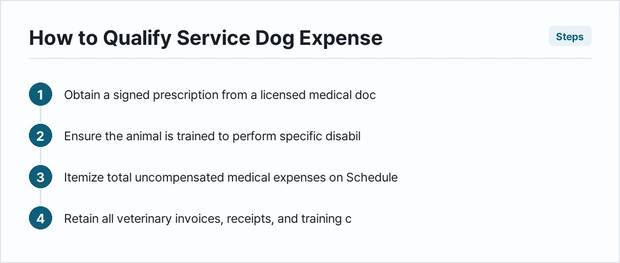
Veterinary bills for a qualifying service animal can count as medical expenses on your federal return, but only if you itemize deductions and only the part of your total medical expenses that exceeds 7.5% of your adjusted gross income (AGI) is deductible. IRS Publication 502 says you can include the costs of buying, training and maintaining a guide dog or other service animal that assists a visually impaired or hearing-disabled person, or a person with other physical disabilities, and that this generally includes food, grooming and veterinary care needed to keep the animal healthy enough to perform its duties (IRS, Publication 502 (2025)). The same publication says ordinary veterinary fees for pets are generally not includible. This guide explains who qualifies, which costs count, how the AGI threshold works, and what records to keep.
This is general information, not tax advice. Consult a tax professional about your situation.
Which Animals Qualify
Publication 502's language covers a guide dog or other service animal that assists a person who is visually impaired, hearing disabled or has other physical disabilities. The key question is whether the animal is used to help with a medical condition or disability, rather than being a companion. A letter from your health care provider describing the condition and how the animal helps is useful documentation, and records of the animal's specific training help show that it is a service animal.
Emotional-support and therapy animals are a gray area for tax purposes; whether their costs count depends on the facts, so get professional advice before claiming them.
Which Costs Count

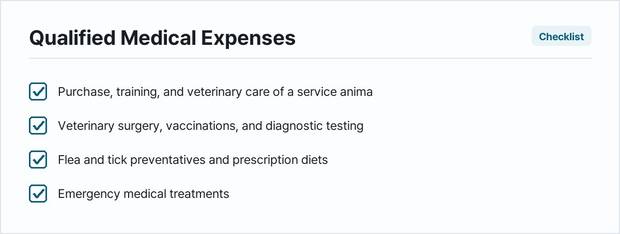
According to Publication 502, includible costs for a qualifying service animal generally cover:
- Buying the animal.
- Training, including specialized task training.
- Maintaining the animal's health and vitality so it can perform its duties — the publication names food, grooming and veterinary care.
Routine wellness visits, vaccinations, emergency treatment and prescribed medicines for the service animal fall under veterinary care. Keep in mind that costs reimbursed by insurance or paid tax-free from an HSA or FSA cannot also be deducted.
How the 7.5% AGI Threshold Works
IRS Publication 502 says you can deduct on Schedule A only the amount of your medical and dental expenses that is more than 7.5% of your AGI. Service animal costs are added to all your other qualifying medical expenses — doctor visits, prescriptions, insurance premiums you pay with after-tax money and so on — before the threshold is applied.
A worked example with made-up numbers: if your AGI were $60,000, the threshold would be 7.5% of that, or $4,500. If your total qualifying medical expenses, including the service animal's care, came to $5,500, you could include $1,000 — the amount above the threshold — on Schedule A. If your total were below $4,500, none of it would be deductible.
Because the threshold rises with income, people with higher AGI need larger medical expenses before any deduction applies.
Itemizing vs. the Standard Deduction
The medical expense deduction is only available if you itemize. If your total itemized deductions — medical expenses above the threshold, plus state and local taxes, mortgage interest, charitable gifts and others — are less than your standard deduction, you would normally take the standard deduction, and service animal costs provide no federal tax benefit. Run the numbers both ways, or let tax software compare them.
Step-by-Step: Claiming Service Animal Expenses
- Confirm the animal qualifies and keep a provider letter and training records.
- Gather receipts for purchase, training, food, grooming and veterinary care during the tax year.
- Add your other medical expenses for the year.
- Subtract reimbursements from insurance and amounts paid from an HSA or FSA.
- Apply the 7.5% AGI threshold.
- Compare itemizing with the standard deduction and report the medical expense on Schedule A if you itemize.
Records to Keep
Publication 502 advises keeping records of your medical and dental expenses to support your deduction and not sending them with a paper return. For a service animal, that means:
- Itemized veterinary invoices showing the animal's name, date and services.
- Receipts for food, grooming and supplies.
- Training invoices and certificates.
- A provider letter describing the disability and the animal's role.
- Proof of payment and any reimbursements.
Paying With an HSA or FSA Instead
If costs for a qualifying service animal are qualified medical expenses, they may also be payable from an HSA or health FSA, subject to the plan's rules. IRS Publication 969 describes FSA qualified expenses as those that would generally qualify for the medical expense deduction. Using pre-tax account money avoids the 7.5% threshold entirely, but the same expense cannot be both reimbursed tax-free and deducted.
Quick Reference
| Question | Answer under IRS Publication 502 |
|---|---|
| Are a service animal's vet bills includible? | Yes, as part of maintaining a qualifying service animal |
| Are ordinary pet vet bills includible? | Generally no |
| What else counts? | Buying, training, food and grooming |
| How much is deductible? | Only total medical expenses above 7.5% of AGI |
| Do I need to itemize? | Yes |
Common Mistakes
- Claiming costs for a pet. Publication 502 says ordinary veterinary fees generally are not includible.
- Forgetting the threshold. Only the amount of total medical expenses above 7.5% of AGI counts.
- Double-dipping. Expenses reimbursed by insurance or paid from an HSA or FSA cannot also be deducted.
- Weak documentation. Without a provider letter and itemized receipts, it is harder to show the animal is a service animal and that the costs maintained it.
State Returns
State income tax rules differ. Some states follow the federal medical expense rules, some have their own thresholds, and some do not allow the deduction at all. Check your state tax agency's instructions for the current year before assuming the federal treatment carries over.
Planning Ahead
Because the deduction only helps when medical expenses are high relative to income, timing can matter. If you expect a year with large medical costs — surgery, a new service animal and its training, or major dental work — grouping expenses into the same tax year can make it more likely that the total clears the threshold. A tax professional can help you weigh this against other factors.
Frequently Asked Questions
Can I deduct my pet's vet bills?
Generally not. Publication 502 says veterinary fees usually are not includible unless they are for a qualifying service animal.
Does food for a service dog count?
Yes. Publication 502 names food among the costs of maintaining a service animal so it can perform its duties.
Is there a dollar limit on service animal expenses?
There is no separate cap in Publication 502; the expenses are subject to the overall 7.5% AGI threshold.
What if I don't itemize?
Then the medical expense deduction does not apply, though HSA or FSA funds may still be used if your plan allows.
Key Takeaways
- Costs of buying, training and maintaining a qualifying service animal, including vet care, are includible medical expenses.
- Only total medical expenses above 7.5% of AGI are deductible, and only if you itemize.
- Ordinary pet costs do not qualify.
- Keep detailed receipts and a provider letter.
Sources and References
- Internal Revenue Service, Publication 502 (2025), Medical and Dental Expenses — guide dog or other service animal; 7.5% of AGI threshold; recordkeeping (read October 9, 2026).
- IRS, Publication 969 (2025), Health Savings Accounts and Other Tax-Favored Health Plans (read October 9, 2026).
Disclaimer
This article is general information, not financial, tax or legal advice. Rules, rates and eligibility change and depend on where a reader lives and on their own situation. Figures here are illustrative; confirm current terms with the provider or agency involved, and consult a licensed professional before acting on a decision that carries real money.