Direct answer
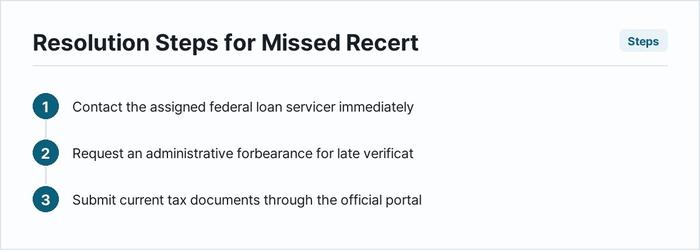
Missing the annual recertification deadline for an income-driven repayment plan causes the monthly payment to temporarily jump to the higher standard repayment amount. Loan servicers automatically strip away the income-based calculation when verification documents do not arrive on time. The quickest resolution is contacting the assigned federal loan servicer immediately, requesting an administrative forbearance while processing late income verification, and submitting current tax documents through the official federal student aid portal. This sequence rules out long-term billing disruption and stops the temporary higher payment from locking into the billing cycle.
Borrowers often panic when the higher bill arrives, assuming the affordable payment option is lost forever. In reality, federal student loan regulations allow late recertification. The financial penalty is usually short-lived, provided the borrower acts swiftly to supply the missing paperwork. Ignoring the notice guarantees that the elevated payment amount remains active, which can strain personal finances and lead to missed payments if the new figure exceeds the borrower's actual monthly budget.
Understanding the administrative mechanics behind loan servicing prevents unnecessary anxiety. Servicers operate under strict federal guidelines that dictate how and when billing amounts change. When a deadline passes without a renewal application, automated systems transition the account out of the income-driven structure. Reversing this transition requires manual intervention from the servicer after reviewing updated income data. Knowing this process highlights why direct communication with the support representative is far more effective than simply waiting for a system update to occur on its own.
What this usually means
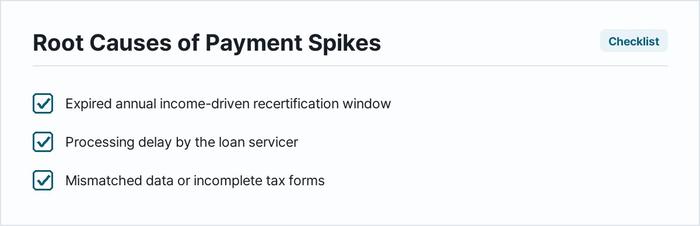
A sudden spike in a monthly student loan bill almost always points to a missed annual income verification window. When borrowers fail to submit their income documentation before the designated date, several specific things occur within the billing system. Identifying the root cause ensures that the borrower takes the correct corrective action rather than wasting time on ineffective troubleshooting steps.
The primary cause is an expired recertification window. Every income-driven repayment plan requires an annual review. If the borrower misses the notification emails, physical mailers, or digital alerts sent by the servicer, the system defaults to the standard repayment plan calculation. This calculation ignores household size and current earnings, basing the new monthly payment strictly on the original loan balance and a ten-year repayment timeline.
A secondary cause is a processing delay by the loan servicer. Sometimes a borrower submits documentation close to the deadline, but the servicer fails to review the paperwork before the billing cycle rolls over. This results in an erroneous payment increase even though the paperwork was technically submitted on time. Distinguishing between a late submission and a processing delay requires checking the submission confirmation receipts provided by the online portal.
Another common cause involves mismatched data or incomplete tax forms. If the submitted income documentation lacks required signatures, displays incorrect figures, or fails to verify through the automated Internal Revenue Service data retrieval tool, the servicer rejects the application. The system then treats the recertification as incomplete, triggering the fallback standard payment amount. Reviewing rejection notices in the online message center clarifies whether the paperwork needs a simple correction or a complete resubmission.
What to do, in order
Review online account messages and billing statements. Log into the official loan servicer portal and check the notification center for any specific rejection notices or recertification status updates. This step rules out whether the paperwork was actually received and processed or flagged for an error. Checking the message center directly prevents guessing about the status of the account and provides concrete reference numbers for future phone calls. If the system shows the application was rejected due to a missing signature, the fix requires only a quick digital resubmission rather than starting the entire application process over from scratch.
Contact the loan servicer via telephone. Speak directly with a customer service representative and explicitly request an administrative forbearance while resolving the late recertification. This step rules out immediate delinquency or default while the updated income information undergoes manual review. Representatives can place a temporary hold on the account that prevents the higher standard payment from being enforced while the paperwork clears. Be sure to write down the representative name, date, and confirmation number for the forbearance request to maintain an accurate record of the conversation.
Submit updated income documentation through the official portal. Complete a new income-driven repayment application using the IRS data retrieval tool or by uploading recent tax returns and pay stubs. This step rules out continued reliance on outdated financial information and initiates the official recalculation process. Ensure that all household size figures and tax year references are completely accurate to avoid secondary rejections. Submitting digital copies through the secure portal ensures a time-stamped record that serves as proof of compliance if processing delays occur later.
Request a retroactive adjustment if the higher payment posted. If the standard payment already processed and caused financial hardship, ask the servicer to apply the newly calculated income-driven amount retroactively to the billing cycle. This step rules out permanent overpayment and helps credit the extra funds toward future months or refund the difference depending on servicer policy. While servicers vary in their ability to refund processed payments, asking for this adjustment is a critical step for borrowers who experienced unexpected budget gaps due to the delayed paperwork.
When you cannot reach the servicer portal
Account access issues related to missed recertification deadlines occasionally stem from local technology failures rather than direct servicer errors. If a borrower cannot log into the loan portal to submit documents, the problem might reside in the user device or network connection rather than the federal student loan system itself. Differentiating between a server outage and a local hardware or browser configuration problem ensures the borrower does not waste hours attempting to fix a functional online platform.
To test local hardware and software functionality, clear the web browser cache and cookies, or attempt to log into the portal using an alternative device such as a smartphone or tablet connected to a cellular data network. If the login page loads normally on the mobile device, the issue points to a browser extension or security software restriction on the primary computer. Updating the primary web browser or disabling strict ad-blocking extensions usually resolves local rendering errors that prevent secure form submission.
If the portal returns generic server error codes across all tested devices and networks, the loan servicer website is experiencing an outage. In this scenario, waiting for system restoration is the only viable course of action, though borrowers should take screenshots of the error screen with a timestamp as evidence of a technical barrier if the deadline falls on that specific day. Documenting system downtime protects the borrower from administrative penalties if technical issues prevent timely online submission.
| Symptom | Likely cause | What to do |
|---|---|---|
| Monthly bill doubled without warning | Missed annual recertification deadline | Contact servicer and submit late income documentation immediately |
| Portal shows application pending | Servicer processing backlog | Request administrative forbearance to pause payments |
| Form rejected for missing data | Incomplete tax or household size details | Correct errors and resubmit through the secure online portal |
| Unable to load repayment website | Browser cache issue or server outage | Clear browser data or test login using a mobile device |
| Interest capitalized after deadline | Transition to standard repayment plan | Recertify income to resume affordable monthly terms |
| Unresponsive customer service line | High call volume periods | Use secure messaging within the portal to create a written record |
How to keep it from happening again
Preventing future missed recertification deadlines requires establishing proactive calendar reminders and maintaining organized digital records of tax documents. Loan servicers send renewal notices several weeks before the deadline, but these communications frequently get lost in crowded email inboxes or overlooked in physical mail delivery. Setting a recurring annual calendar alert two months prior to the historical recertification month provides ample time to gather required tax information without rushing.
Borrowers should also opt into electronic notifications and text message alerts through their loan servicer account portal. This ensures that urgent billing updates and recertification windows arrive immediately on personal mobile devices rather than sitting unread in an email folder. Keeping contact information, mailing addresses, and email accounts updated within the portal guarantees that reminder notices reach the borrower without delay.
Finally, linking the federal student loan account to automated annual income recertification tools, when available through updated federal policy, eliminates manual paperwork entirely. Utilizing automated data sharing allows the system to pull verified tax data directly from the government database each year, maintaining the income-driven repayment status seamlessly without requiring active human intervention or paper forms.
Can I change my repayment plan after recertifying?
Borrowers can switch between eligible income-driven plans at any time by submitting a new application through the federal student aid website, provided they meet the specific eligibility criteria for the requested plan.
What happens if I cannot afford the standard payment during processing?
Requesting an administrative forbearance halts payments temporarily while the servicer processes the late recertification forms, protecting the borrower from immediate delinquency.
Does my loan term reset when I recertify late?
Recertifying late does not reset the overall repayment timeline required for loan forgiveness programs, though any unpaid interest that accumulated during the gap may be capitalized.
Are recertification deadlines the same for all loan types?
Deadlines vary depending on when the specific borrower originally entered the repayment plan and which loan servicer manages the federal account.
Should I mail paper documents if the website fails?
Mailing paper documents serves as a backup method, but uploading files directly through the secure online portal remains significantly faster and provides immediate electronic confirmation.
🔢 Try our free Pet Medication Dosage Calculator
Calculate Now →Frequently Asked Questions
Can I recertify my income after the deadline has passed?
Yes, borrowers can submit their late income documentation to their loan servicer at any time. However, processing takes several weeks, and the previous payment amount will not automatically resume until the servicer reviews the new forms.
Will my missed recertification be reported to credit bureaus?
Missing a recertification deadline alone does not trigger a default immediately, but the resulting payment shock or missed higher payments can lead to delinquency and negative credit reporting if left unaddressed.
What happens to the interest that accumulated during the standard payment period?
Any unpaid interest that accrued while the loan was in the standard or temporary payment state may be capitalized, meaning it is added to the principal balance of the loan, increasing the overall total owed.
How long does it take for the loan servicer to process late recertification forms?
Loan servicers typically require up to several weeks to process income-driven repayment applications, depending on current processing backlogs and the accuracy of the submitted tax documentation.
Do I need to submit new tax documents if my income has not changed?
Borrowers must still complete the recertification process annually by linking their federal tax information or submitting alternative proof of income, even if earnings remain identical to the previous year.
Disclaimer
This article is general information, not financial, tax or legal advice. Rules, rates and eligibility change and depend on where a reader lives and on their own situation. Figures here are illustrative; confirm current terms with the provider or agency involved, and consult a licensed professional before acting on a decision that carries real money.