Direct answer
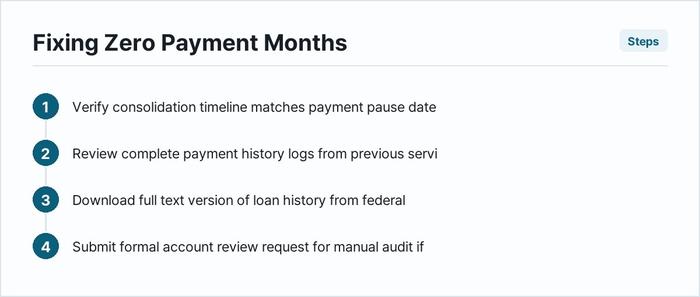
When zero payment months fail to appear in qualifying history during income-driven repayment count adjustments, the issue typically stems from unprocessed loan status transitions, incomplete consolidation histories, or delays in data synchronization between loan servicers and federal databases. The quickest corrective action is to verify that the consolidation timeline matches the exact dates of the payment pause or administrative forbearance periods on the borrower dashboard. Ruling out simple display errors prevents unnecessary formal disputes while ensuring that underlying tracking discrepancies are identified early. Borrowers should first review their complete payment history logs to confirm whether the specific zero-payment months were properly recorded by the previous servicer before escalating the matter through official federal complaint channels.
System update delays often create temporary discrepancies where qualifying months sit in a pending queue rather than the active count display. Checking the raw data files or downloading the full text version of the loan history from the primary federal student aid portal often reveals months that the graphical user interface fails to render correctly. If the downloadable text file shows the months, the problem is strictly a visual rendering bug within the dashboard rather than a missing payment credit. If the text file omits the months, a formal account review request is required to trigger a manual audit by loan consolidation specialists. Proceeding systematically through verification steps ensures that users do not waste time repeating actions that have already been processed by automated background updates.

What this usually means
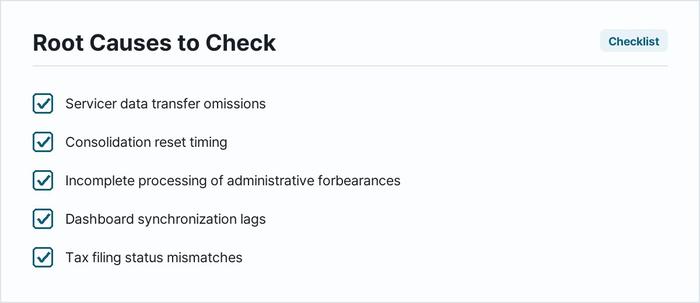
Missing zero payment months during income-driven repayment adjustments generally point to specific administrative gaps in the tracking framework. Understanding these root causes helps borrowers choose the correct resolution path without causing further processing delays.
- Servicer data transfer omissions: When loans transfer between different servicing organizations, historical payment records, deferment statuses, and forbearance periods occasionally fail to migrate completely. This leaves gaps in the digital ledger where zero-payment months should populate automatically.
- Consolidation reset timing: Consolidating older federal loans into a new direct consolidation loan creates a new loan identification number. If the historical credit application rules are misapplied during this consolidation process, pre-consolidation months marked as zero payments under eligible forbearances might temporarily drop out of the cumulative tally.
- Incomplete processing of administrative forbearances: Certain types of mandatory or administrative forbearances require explicit coding flags to qualify for the adjustment. If a servicer applied the wrong status code during past economic hardships, the automated counting script skips those specific blocks of time.
- Dashboard synchronization lags: Federal student aid websites update their backend databases in batches. A borrower might see updated totals for standard repayment periods while zero-payment months remain stuck in a legacy queue waiting for secondary validation sweeps.
- Tax filing status mismatches: Discrepancies between historical income recertification deadlines and actual IDR anniversary dates can flag months as ineligible due to perceived non-compliance, even when no payment was legally due during those specific calendar windows.
What to do, in order
Download and inspect the raw text data file from the primary student aid portal. Log into the official federal student aid website, navigate to the My Aid section, and locate the option to download loan details in a plain text format. Open this file in a basic text editor and search for the specific periods in question. This step rules out browser rendering errors and simple user interface glitches, confirming whether the database itself recognizes the zero-payment months. If the raw file shows the months, the issue is purely visual; if it does not, a structural data error exists.
Compare historical billing statements against the consolidation disbursement date. Gather PDF statements or digital records from past loan servicers covering the exact dates of the missing zero-payment months. Check whether these months occurred before or after a federal loan consolidation event. This step rules out consolidation cutoff date misunderstandings, verifying that the months fall safely within the eligible window established by federal adjustment guidelines.
Submit a formal request for reconsideration through the federal feedback system. If the raw data file confirms that the zero-payment months are missing from the official record, use the official feedback portal on the student aid website to submit a targeted inquiry. Select the category related to IDR account adjustments and payment counts. This step formally escalates the file to human auditors, ruling out automated processing loops and forcing a manual review of the underlying loan history by specialized federal personnel.
File a complaint with the federal student aid ombudsman group. If a formal reconsideration request yields no movement or results in an incorrect rejection after an extended waiting period, submit a detailed complaint via the ombudsman feedback tool. Include copies of past servicer billing statements, consolidation letters, and the downloaded raw text file. This step rules out routine customer service bottlenecks, placing the account under regulatory oversight to compel the current servicer and the Department of Education to reconcile the missing history.
Quick reference: symptom, likely cause, what to do
| Symptom | Likely cause | What to do |
|---|---|---|
| Zero payment months visible in text file but missing on webpage | Browser cache or UI rendering lag | Clear browser cache, disable extensions, or test on a secondary device |
| Entire blocks of forbearance missing after consolidation | Servicer transfer omission | Gather historical statements and submit a formal reconsideration inquiry |
| Count updated for some loans but not others in a consolidated group | Asynchronous batch processing | Wait for the next system-wide synchronization cycle before filing disputes |
| Months marked as ineligible due to missing income documentation | Recertification tracking mismatch | Provide proof of active forbearance or deferment status during those dates |
| Zero movement on count totals for over six months | Stalled account review queue | Escalate the issue to the federal student aid ombudsman group with documentation |
| Incorrect pre-consolidation weighted average applied | Calculation error under adjustment rules | Request a manual audit citing specific federal adjustment guidelines |
How to keep it from happening again
Preventing future discrepancies in income-driven repayment counts requires maintaining a meticulous personal archive of every document related to federal student loans. Borrowers should download and securely store monthly billing statements, annual tax returns used for IDR recertification, and written confirmation letters for any period of deferment or forbearance. When changing loan servicers, users must download a complete transaction history report from the outgoing servicer portal immediately before the account transfer takes effect. This ensures that historical data remains accessible even if the new servicer experiences migration delays or drops records during database integration.
Regularly reviewing the official federal student aid dashboard helps catch count discrepancies before they become deeply entrenched in the system. Setting a calendar reminder to check loan details every few months allows borrowers to identify stalled updates or missing zero-payment adjustments early. Keeping communication records organized in a single digital folder streamlines the evidence-gathering process should a formal dispute become necessary, ensuring that missing history can be corrected swiftly without prolonged administrative friction.
Can zero payment months from older commercial FFEL loans count toward the adjustment?
Yes, provided the borrower consolidated those commercial loans into a direct consolidation loan by the designated federal program deadlines. Once consolidated, the prior history, including eligible forbearances and deferments, is evaluated under the adjustment rules.
Why do some zero payment months appear on the federal portal but not on the current loan servicer portal?
Loan servicers often display only active repayment tracking metrics, whereas the central federal student aid database houses the full historical adjustment data processed under federal oversight.
What happens if a past servicer went out of business and no billing records exist?
Federal student aid systems retain historical records of loan statuses through the National Student Loan Data System. If servicer records are missing, the central federal database serves as the authoritative source for validating past periods.
Does changing IDR repayment plans reset the accumulated zero payment month count?
No, switching between eligible income-driven repayment plans does not erase previously accumulated qualifying months or adjustment counts already credited to the account history.
How long does a manual audit take after submitting a formal reconsideration request?
Processing times vary significantly based on federal workload volumes and the complexity of the consolidation history, often ranging from several weeks to multiple months for complete resolution.
Disclaimer
This article is general information, not financial, tax or legal advice. Rules, rates and eligibility change and depend on where a reader lives and on their own situation. Figures here are illustrative; confirm current terms with the provider or agency involved, and consult a licensed professional before acting on a decision that carries real money.