What "Remanded" Means on a Borrower Defense Application
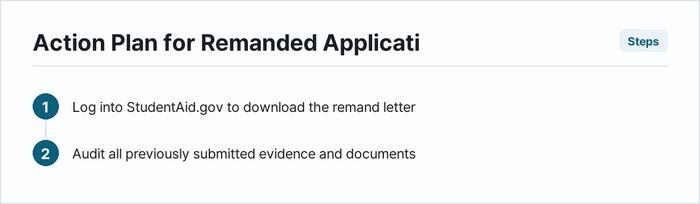
A borrower defense application marked "remanded" has been sent back for further review; it is neither an approval nor a denial, and the most important thing you can do is read the notice that came with the change and respond to anything it asks for. Borrower defense to repayment lets federal Direct Loan borrowers ask the U.S. Department of Education to discharge loans when their school's misconduct — such as misrepresentation — relates to the loans or the education they paid for. The federal regulations set out how applications are submitted, reviewed and decided; status labels such as "remanded" describe where a file sits in that process. This guide explains what the regulations say about the review, what remand usually implies in practice, and the steps to take now.
This is general information, not legal advice. The Department's notice to you and the Federal Student Aid office are the authoritative sources for your case.
How Borrower Defense Review Works Under the Regulations
The rules depend on when your loans were first disbursed. Title 34 of the Code of Federal Regulations, section 685.222, covers loans first disbursed on or after July 1, 2017 and before July 1, 2020, and points loans first disbursed before July 1, 2017 to the standards in section 685.206(c) (eCFR, 34 CFR 685.222). Later loans fall under other provisions. For an individual application under section 685.222(e), the regulation describes this sequence:
- Application: the borrower submits a form certifying the loan was used to attend the named school, provides supporting evidence, and discloses any payments received from third parties such as tuition recovery programs.
- Forbearance or collection pause: on receipt, if the borrower is not in default, the Secretary grants forbearance and tells the borrower they may decline it and keep paying; information about income-driven repayment is provided.
- Fact-finding: a designated Department official reviews the application, notifies the school, and considers the borrower's evidence, Department records, the school's response and other information.
- Written decision: the official approves or denies the claim in full or in part, explaining the reasons and any relief.
- Reconsideration: after a denial, the borrower may request reconsideration based on new evidence, and the Secretary may reopen an application to consider evidence not previously considered.
What a Remand Usually Implies

In general legal usage, a remand sends a matter back to an earlier stage for more work. For borrower defense, a remanded status typically means the file has been returned for additional review — for example, to apply a different legal standard, to examine evidence again, to consider new information, or because a reconsideration or reopening was granted. It does not, by itself, tell you the outcome. Because the reason varies, the notice attached to the status change is the only reliable explanation for your file.
Steps to Take Now
- Download and read the notice. Log in to your StudentAid.gov account and save every message and letter about your application. Note any request for information and the deadline stated in the notice.
- Respond to requests completely. The regulation requires borrowers to provide information reasonably requested by the Secretary, and relief can depend on cooperation. Answer each point the notice raises.
- Organize your evidence. Enrollment agreements, recruitment materials, emails, catalogs, transcripts, job-placement claims, and notes of what you were told. Explain how each item relates to the misconduct you allege.
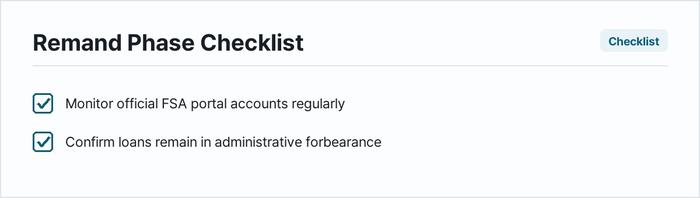
- Check your loan status with your servicer. Confirm whether your loans are in forbearance or another status, and keep records of every call and letter.
- Decide whether to keep paying. The regulation says borrowers are told they may decline forbearance and continue payments. Consider your situation, including whether income-driven repayment could lower payments if the claim is denied.
- Watch your credit reports. Check that your loans are reported accurately and dispute errors with the credit bureaus and your servicer.
Possible Outcomes After Review
Under section 685.222(e), the Department official's written decision can approve the claim in full or in part, describing the relief, or deny it in full or in part. For a denial, the regulation says the notice explains the reasons, the evidence relied upon, any portion of the loan that is due, and whether amounts previously collected will be reimbursed, and that any remaining balance returns to its prior status. A denial can be followed by a request for reconsideration based on new evidence.
Group Claims and Settlements
The regulations also allow the Secretary to consolidate applications with common facts and claims and resolve them as a group. Separately, some borrowers are covered by court settlements that set their own procedures. If you received a notice about a group process or settlement, follow its instructions, which may differ from the individual process described above.
Costs and Help
Applying for borrower defense through StudentAid.gov is free. Be wary of companies that charge fees to file or "speed up" a borrower defense application; you can apply and respond to requests yourself. Legal aid organizations and some law school clinics help borrowers with these claims. Keep in mind that, depending on your loan status and the outcome, interest may continue to matter if a claim is denied — ask your servicer how interest is handled on your loans during review.
Status Labels at a Glance
| Status or event | What it generally means | What to do |
|---|---|---|
| Application received | Review process starting | Confirm loan status with your servicer |
| Pending or under review | Fact-finding under way | Keep contact details current; watch for requests |
| Remanded | Returned for further review | Read the notice; respond to any request |
| Approved (full or partial) | Relief granted as described | Confirm the discharge with your servicer |
| Denied (full or partial) | Claim not granted as described | Review reasons; consider reconsideration with new evidence |
Keeping a Clear Record
Borrower defense cases can take a long time, and the people handling your file may change. A simple log protects you: the date you applied, every status change, each notice and what it asked for, what you sent and when, and every contact with your servicer, including the name of the person you spoke with. Save confirmation pages and screenshots of uploads. If you move or change email addresses, update your contact information with Federal Student Aid and your servicer right away so you do not miss a request.
When writing a supplemental statement, be specific. Describe what the school told you, when and how, why you relied on it, and how it affected your decision to enroll or borrow. Attach the documents that support each point and refer to them by name. A clear, organized submission is easier to evaluate than a large, unlabeled pile of files.
Frequently Asked Questions
Does a remand mean my claim was denied?
No. A remand returns the file for further review. Only a written decision approves or denies a claim.
Do I have to send new documents?
Only if the notice asks for them, but you may provide evidence you did not include before. Answer any request by the deadline in your notice.
Will my loans go back into repayment?
Check with your servicer. Under section 685.222(e), borrowers not in default are granted forbearance when an application is received, and may choose to keep paying.
Should I pay someone to handle my application?
Applying is free. Free help is available from legal aid organizations and some school clinics.
Key Takeaways
- "Remanded" means further review, not a decision.
- Read the notice and respond completely to any request.
- Confirm your loan status with your servicer and keep records.
- Denials can be followed by reconsideration based on new evidence.
Sources and References
- Electronic Code of Federal Regulations, 34 CFR 685.222 — Borrower defenses and procedures (read October 9, 2026).
- eCFR, 34 CFR 685.206 — Borrower responsibilities and defenses (read October 9, 2026).
Disclaimer
This article is general information, not financial, tax or legal advice. Rules, rates and eligibility change and depend on where a reader lives and on their own situation. Figures here are illustrative; confirm current terms with the provider or agency involved, and consult a licensed professional before acting on a decision that carries real money.