Moderna’s Personalized Cancer Vaccine Passes a Phase 3 Test: What the Result Really Means
Moderna and Merck have announced a landmark result for intismeran autogene, the experimental treatment previously known as V940 or mRNA-4157. In the global Phase 3 INTerpath-001 trial, the personalized mRNA therapy combined with pembrolizumab (Keytruda) met the study’s primary endpoint of recurrence-free survival and a key secondary endpoint of distant-metastasis-free survival in patients with high-risk melanoma whose tumors had been completely removed.
The announcement matters because it is the first positive Phase 3 readout reported for an individualized neoantigen therapy and for an mRNA-based cancer treatment. But the headline needs careful interpretation. This is not a preventive vaccine for the general public, it does not treat every cancer, and it has not yet received regulatory approval.
What is intismeran?
Intismeran is made separately for each patient. After surgery, scientists analyze the DNA sequence of the patient’s tumor and identify mutations that are not present in healthy cells. An algorithm selects up to 34 tumor-specific neoantigens—abnormal molecular targets that may help the immune system distinguish the cancer from normal tissue.
A synthetic mRNA sequence encoding those selected targets is then manufactured for that individual. After administration, the mRNA instructs cells to produce the selected neoantigens temporarily. The goal is to activate T-cells that recognize tumor cells carrying the same targets.
The treatment is being tested with Keytruda, an anti-PD-1 immunotherapy. Keytruda helps release a brake that cancers can use to evade immune attack, while the personalized mRNA component is designed to show the immune system what to look for. The two treatments therefore address different parts of the same problem.

What did the Phase 3 trial test?
INTerpath-001 is a randomized, double-blind global trial involving 1,137 adults with completely resected stage IIB, IIC, III or IV cutaneous melanoma. Participants were assigned in a 2:1 ratio to receive either intismeran plus Keytruda or Keytruda alone.
The primary endpoint was recurrence-free survival: the length of time before melanoma returned or the patient died from any cause. A key secondary endpoint was distant-metastasis-free survival, which measures the time before cancer spreads to a distant organ or the patient dies.
At a prespecified interim analysis, the combination produced statistically significant and clinically meaningful improvements in both endpoints compared with Keytruda alone, according to the companies. The study is continuing to evaluate overall survival, safety, tolerability and quality of life.
What we still do not know
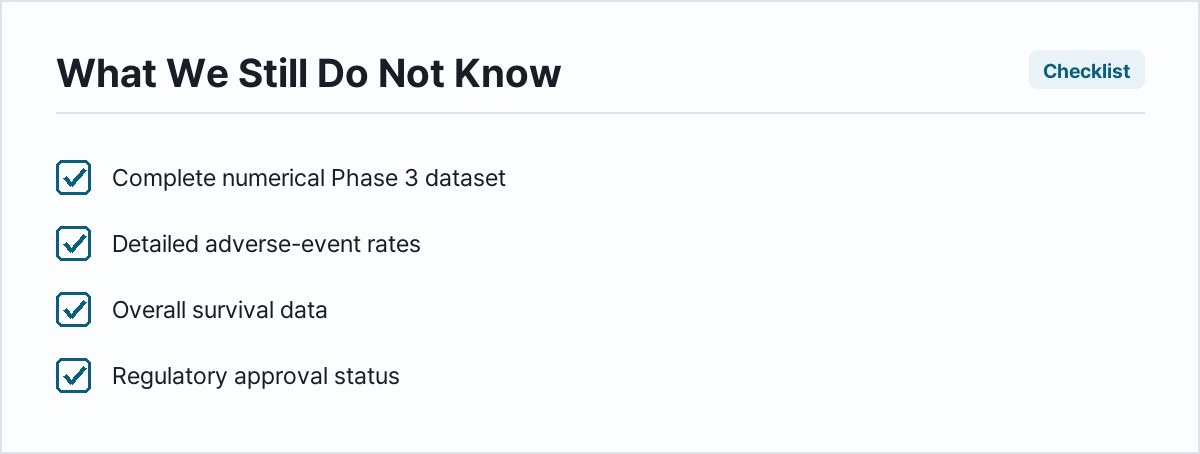
The topline announcement did not provide the complete numerical Phase 3 dataset. That means the exact size of the benefit, detailed adverse-event rates, subgroup results and full statistical analysis still need to be presented at a medical meeting or published in a peer-reviewed journal.
Overall survival is also not yet established. A treatment can delay recurrence without necessarily proving that patients live longer, so the survival follow-up remains important.
Regulatory review is another separate step. A positive Phase 3 trial can support an application, but it is not the same as approval. Manufacturing speed and price will also matter because every dose is designed from one patient’s tumor rather than produced as one identical product for everyone.
How strong were the earlier results?
The Phase 3 study was built on the smaller Phase 2b KEYNOTE-942 trial. In a five-year follow-up reported by Merck and Moderna, intismeran plus Keytruda was associated with a reduction in the risk of recurrence or death and a reduction in the risk of distant metastasis or death compared with Keytruda alone.
Those percentages describe relative risk reductions in the earlier trial. They should not be presented as cure rates, and they are not automatically the final effect sizes for the larger Phase 3 study.
Could the approach work in other cancers?
The companies are studying the platform in several tumor types, including non-small cell lung cancer, bladder cancer and kidney cancer. Each cancer has different biology, however, so a melanoma success does not guarantee the same result elsewhere.
The broader significance is the production model: sequence a tumor, identify its unique targets, manufacture an individualized mRNA therapy, and combine it with an immune-checkpoint drug. If the Phase 3 result survives full scientific and regulatory review, it could establish personalized mRNA treatment as a practical new branch of cancer immunotherapy.
Visual evidence guide
| At a glance | Answer |
|---|---|
| Treatment | Patient-specific mRNA neoantigen therapy plus pembrolizumab |
| Disease setting | Completely resected, high-risk cutaneous melanoma |
| Trial stage | Phase 3 |
| Status | Positive topline result; not yet regulatory approval |
| Step | What happens | Purpose |
|---|---|---|
| 1. Sequence | Compare tumor and normal DNA | Find tumor-specific mutations |
| 2. Select | Choose up to 34 neoantigens | Prioritize immune targets |
| 3. Manufacture | Produce patient-specific mRNA | Create a made-for-one therapy |
| 4. Combine | Administer with pembrolizumab | Show targets while releasing an immune brake |
| Component | Main job | Simple analogy |
|---|---|---|
| Personalized mRNA therapy | Displays selected tumor targets | A wanted poster |
| Pembrolizumab | Blocks PD-1 immune suppression | Releasing a brake |
| Trial feature | INTerpath-001 design |
|---|---|
| Participants | 1,137 adults |
| Melanoma stages | Resected stage IIB, IIC, III or IV |
| Allocation | 2:1 combination versus pembrolizumab alone |
| Primary endpoint | Recurrence-free survival |
| Key secondary endpoint | Distant-metastasis-free survival |
| Endpoint | Measures | Does not prove alone |
|---|---|---|
| Recurrence-free survival | Time before recurrence or death | That every patient is cured |
| Distant-metastasis-free survival | Time before distant spread or death | A final overall-survival benefit |
| Overall survival | Time until death from any cause | Still requires longer follow-up |
| Known now | Still pending |
|---|---|
| Both announced efficacy endpoints were met | Exact absolute benefit and hazard ratios |
| The trial enrolled a large global population | Detailed subgroup results |
| Follow-up is continuing | Overall-survival maturity |
| The regimen is individualized | Full safety, manufacturing and access details |
Relative reductions reported by Merck and Moderna in their five-year Phase 2b update:
| Earlier Phase 2b signal | Reported relative reduction | Correct reading |
|---|---|---|
| Recurrence or death | 49% | Relative comparison, not a cure rate |
| Distant metastasis or death | 59% | Not automatically the Phase 3 effect size |
| Potential advantage | Real-world bottleneck |
|---|---|
| Targets an individual tumor | Sequencing quality and tissue availability |
| Encodes many neoantigens | Target-selection accuracy |
| Pairs with established immunotherapy | Manufacturing turnaround time |
| May extend to other cancers | Each tumor type needs independent evidence |
Common misreadings of the figures reported by Merck and Moderna:
| Common headline | Evidence-based correction |
|---|---|
| “A universal cancer vaccine” | No. It is individualized and studied in a specific melanoma setting. |
| “Phase 3 means approved” | No. Full data and regulatory review come next. |
| “49% means 49% cured” | No. It is an earlier trial's relative risk comparison. |
| “It now works in every cancer” | No. Other tumor types need separate trials. |
| Next milestone | Question to answer |
|---|---|
| Full presentation | How large and consistent was the benefit? |
| Peer-reviewed paper | Do methods and subgroup results withstand scrutiny? |
| Longer follow-up | Does benefit extend to overall survival? |
| Regulatory review | Do benefits outweigh risks? |
| Access planning | Can a made-for-one therapy be delivered quickly and affordably? |
Bottom line
The accurate headline is not “Moderna cured cancer.” The real result is more specific and still historically important: a made-for-one mRNA therapy combined with Keytruda improved key recurrence and metastasis endpoints in a large Phase 3 trial for surgically treated high-risk melanoma.
The next evidence to watch is the complete Phase 3 dataset, overall-survival follow-up, safety details, regulatory filings and results from trials in other tumor types.
Official sources
- Moderna and Merck Phase 3 announcement
- INTerpath-001 clinical-trial record
- Merck and Moderna five-year Phase 2b update
This article is for general education and is not medical advice.
Disclaimer
This article is general information, not medical advice. It cannot account for an individual's history, medications or risk factors. Anyone weighing a treatment, a test or a change in medication should speak with a qualified healthcare professional first, and treat urgent symptoms as an emergency rather than a research question.