Short answer
A dream about falling is one of the most commonly reported dream experiences, and it rarely has a single fixed meaning. Dream dictionaries commonly read it as a signal of lost control, a warning about a shaky situation in waking life, or a sign that something a person has built is at risk of slipping away, and modern commentary often links it to feelings of instability, anxiety about a transition, or the sense of not having a firm footing in a relationship, job, or personal goal. Neither of those readings is found in the sources cited at the end of this article, so both are framing rather than evidence. The details of the dream, including setting, speed, and how the dream ends, tend to shape which interpretation feels closer to a person's actual situation.

Why the details change the reading
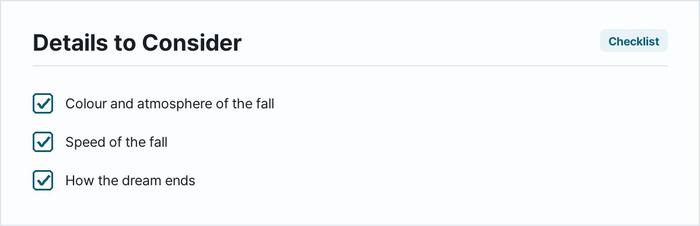
Dream dictionaries and informal folklore rarely treat falling as one uniform symbol. The specific texture of the dream, such as where the fall happens, what color or atmosphere surrounds it, how the body moves, and what emotion rises up during the fall, all shift the way the dream tends to be discussed.
Colour and atmosphere
A fall through bright daylight is sometimes described differently in traditional dream lore than a fall through darkness or fog. Lighter, open settings are occasionally read as a milder version of the same loss-of-control theme, while murky or shadowed falls are sometimes described as more unsettling. Psychologically, the mood of the surroundings may simply mirror the emotional tone a person is carrying into sleep rather than pointing to anything specific about the future.
Setting
Falling from a building, a cliff, a staircase, or through open space each carry their own flavor in folk interpretation. A fall from a height associated with achievement, such as a tall building, is sometimes linked to anxiety about status or reputation, while a fall down stairs is occasionally tied to smaller, everyday setbacks. These are long-standing folk associations rather than confirmed patterns.
Action
Whether the dreamer is pushed, slips, jumps, or simply finds themselves already falling changes the story considerably. Traditional readings sometimes treat being pushed as a sign of feeling undermined by others, while slipping is read as self-doubt. A deliberate jump is sometimes interpreted as a willingness to take a risk, though this remains a matter of folklore rather than evidence.
Emotion
The feeling that accompanies the fall, whether panic, calm, or even something closer to flying, is often considered the most telling detail by those who study dream lore informally. A falling dream that feels oddly peaceful is sometimes described as different in meaning from one that feels terrifying, with the calmer version occasionally linked to acceptance of change rather than fear of it.
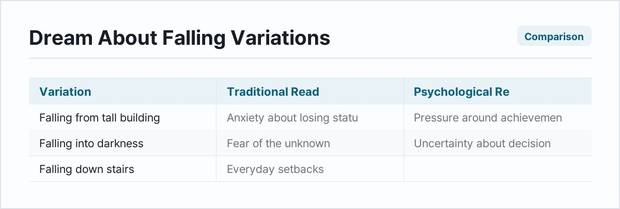
Neither column below is sourced. The left column is what dream dictionaries commonly repeat; the right is modern commentary. Neither is found in the sources cited at the end of this article — the one text we quote (Freud 1913) does not assign these meanings, and the Korean tradition entries we hold do not cover falling at all.
| Variation | Dream-dictionary reading | Modern commentary |
|---|---|---|
| Falling from a tall building | Anxiety about losing status, reputation, or a position built over time. | Pressure around achievement or fear of failing at something visible to others. |
| Falling into darkness or a void | A sign of fear of the unknown or an unresolved worry about what comes next. | Uncertainty about a decision or a period of transition without a clear outcome. |
| Falling and being caught | A sign that support is nearby, even if it does not feel that way while awake. | A need for reassurance or an unmet wish to be looked after by someone trusted. |
| Falling that feels calm or like flying | Acceptance of a change rather than resistance to it. | A readiness to let go of control in a situation that has felt rigid. |
| Being pushed before falling | A sign of feeling undermined or betrayed by someone close. | A conflict with a specific person or a sense of being blamed for something. |
| Falling down stairs | A warning about a small misstep or setback rather than a major loss. | Everyday stress about routine tasks or minor mistakes at work or home. |
| Repeated falling dreams | An ongoing imbalance that has not yet been addressed in waking life. | A persistent stressor, such as an unresolved argument or an open-ended worry. |
| Falling and waking with a jolt | The body or mind signaling sudden alarm about instability. | A known sleep phenomenon called a hypnic jerk, often unrelated to dream content itself. |
Sources
This article cites one primary text directly. Anything attributed to it is quoted below. Anything we could not source is named as such rather than implied.
Sigmund Freud, The Interpretation of Dreams, translation of the third edition by A. A. Brill (New York: The Macmillan Company, 1913). Text used: Project Gutenberg eBook #66048 (public domain in the USA; checked 2026-10-07 — Freud, Brill translation, Macmillan 1913). Two passages bear on falling dreams:
Among these are the well-known dreams of falling from heights, of the falling out of teeth, of flying, and of embarrassment because of being naked or barely clad.
If we lie diagonally across the bed with our feet extending beyond the edge, we may dream of standing on the brink of a terrifying precipice, or of falling from a steep height.
Note what the 1913 text actually does here. It groups falling among typical dreams, and it ties the sensation of falling to the sleeper's body position. It does not say that falling means a loss of control.
What we could not source
- The lost control and shaky situation readings are repeated widely in dream dictionaries. They are not found in these sources, so this guide presents them as a common framing, not as established meaning.
- The Korean tradition entries we hold ([꿈],『한국민족문화대백과사전』, 한국학중앙연구원) record readings for bathing, death, dragon, fire, flying, house, mirror, nakedness and others — falling is not among them. This article therefore carries no Korean-tradition reading for falling.
- The psychological framing (instability, anxiety about a transition) is modern commentary. Not found in these sources.
Sources checked 2026-10-07.
What to look at after the dream
Rather than treating a falling dream as a message to decode, it can be more useful to look at the context the dream appeared in. A few areas worth considering include the following.
- Sleep quality in the nights leading up to the dream, since fragmented or late sleep is associated with more vivid or unsettling dream content in general discussion of sleep.
- Stress levels at work, in relationships, or around finances, since heightened stress is often mentioned alongside more intense dream recall.
- Recent events involving a loss of control, such as a canceled plan, a disagreement, or a decision that did not go as expected.
- Patterns across several nights, since a single falling dream tends to carry less weight in informal interpretation than a recurring one.
- Whatever thought or image was present just before falling asleep, since it sometimes threads into the dream itself.
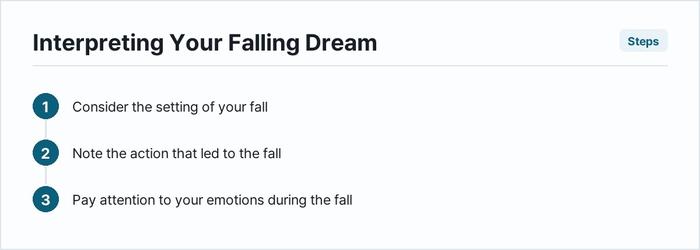
A simple way to reflect on the dream without overreaching is to jot down the setting, the action, and the feeling shortly after waking, then ask whether any of those details echo something happening in daily life. This keeps the reflection grounded in personal context rather than treating the dream as a prediction.
Readings to be careful with
Dream interpretation of this kind is best treated as a reflective exercise rather than a source of guidance for serious matters.
- It should not be used to predict financial outcomes, including lottery numbers, investments, or market movements.
- It should not be treated as a diagnosis or substitute for medical or mental health advice, even if a dream feels physically unsettling.
- It should not be used as the basis for an irreversible decision, such as ending a relationship, quitting a job, or making a major purchase.
- No falling dream should be labeled a good or bad omen as a matter of fact, since both traditional and psychological readings remain interpretive rather than confirmed.
Does a dream about falling always mean something bad is about to happen?
Not necessarily. In traditional dream lore, falling is often tied to a sense of lost control rather than a specific negative event, and many informal interpretations treat it as a reflection of current stress rather than a forecast.
Why do people sometimes jerk awake right as they fall in a dream?
This is often associated with a hypnic jerk, a brief muscle twitch that can occur while drifting into sleep, and it is generally discussed separately from the symbolic content of the dream itself.
Is it normal to have the same falling dream more than once?
Recurring dreams of any kind are commonly reported, and in informal interpretation a repeated falling dream is sometimes linked to an ongoing source of stress that has not been fully addressed, though this remains a general observation rather than a rule.
Does the height of the fall change the meaning?
Some traditional readings suggest that falling from a greater height is tied to bigger concerns, such as status or major life changes, while shorter falls are linked to smaller, everyday worries, though this distinction is folklore rather than an established pattern.
Should a falling dream be interpreted the same way for everyone?
Most approaches to dream interpretation, whether traditional or psychological, treat personal context as essential, so the same dream can be read differently depending on what is happening in an individual's waking life at the time.
Analyzing the Environment of Your Fall
When interpreting a dream about falling, it's essential to consider the environment in which the fall takes place. Different settings can significantly alter the meaning of the dream. For instance, falling from a great height in a familiar place, like your childhood home, may symbolize a sense of insecurity or loss of control in a area of your life that's normally stable. On the other hand, falling in a strange or unknown location may indicate a sense of disorientation or uncertainty. Some common environments to consider:
- At work or school: may relate to job or academic insecurity
- In a relationship or social setting: may indicate feelings of vulnerability or exposure
- In a natural setting, like a mountain or tree: may symbolize a disconnection from nature or the world around you
- In a confined space, like an elevator or room: may represent feelings of claustrophobia or being trapped
Comparing Falling Dreams to Other Types of Dreams
Dreams about falling can often be compared to other types of dreams to gain a deeper understanding of their meaning. For example, dreams about flying or rising are often filed with falling dreams because both involve height, but the traditions treat them as different dreams rather than opposites: falling happens to the dreamer, while flying is something the dreamer does. Similarly, dreams about being chased or pursued may be related to falling dreams, as both can indicate feelings of anxiety or stress. Here's a table comparing different types of dreams:
| Dream Type | Common Themes | Possible Interpretations |
|---|---|---|
| Falling | Loss of control, insecurity, fear | Insecurity, anxiety, transition |
| Flying/Rising | Empowerment, freedom, ascension | Confidence, success, spiritual growth |
| Being Chased/Pursued | Anxiety, stress, fear | Overwhelmed, threatened, need for escape |
What to Do After Having a Dream About Falling
If you've had a dream about falling, there are several steps you can take to process and understand its meaning. First, take some time to reflect on your emotions and thoughts from the dream. Ask yourself what was happening in your life before the dream, and if there were any specific stressors or challenges. Consider keeping a dream journal to track recurring themes or symbols. Some common mistakes to avoid:
- Ignoring the dream or dismissing its significance
- Jumping to conclusions or making assumptions about the meaning
- Failing to consider the context of your life and emotions
- Not taking action to address underlying issues or concerns