Almost every page you will find on this dream says the same two things: that losing a tooth in a dream means losing money, and that Freud connected it to a death in the family. The second claim is checkable, because the book is in the public domain and searchable. The passage in it that deals with this dream says something else.
The passage we are quoting from the 1913 translation of *The Interpretation of Dreams* is short, and it is about the mouth rather than about fate:
The dream of the falling out of teeth is explained by “dental irritation,” which does not, however, of necessity imply a morbid state of excitation in the teeth.
That is the sentence we are relying on. It mentions no money, no relatives and no warning — and to be exact about what we are claiming: we are describing this passage, not summarising a six-hundred-page book. The book covers a great deal we are not quoting, including material we leave out by choice. The book groups the dream with a small set it calls well known — falling, flying, and being seen undressed — and treats them as dreams that recur across people rather than as messages with fixed meanings:
Among these are the well-known dreams of falling from heights, of the falling out of teeth, of flying, and of embarrassment because of being naked or barely clad.
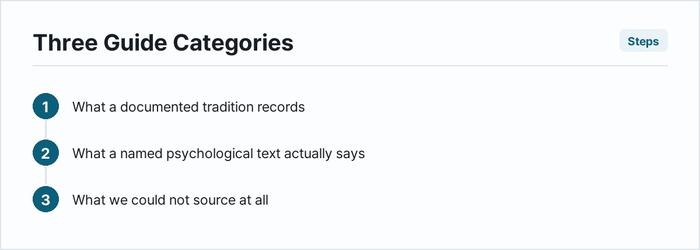
So this guide keeps three things apart, and labels every one of them. Mixing them is what makes most dream pages useless.
- What a documented tradition records. Here, one line from a national encyclopaedia.
- What a named psychological text actually says. Here, two sentences from 1913.
- What we could not source at all — and there is more of this than you would expect.

1. Traditional interpretation: what is actually recorded
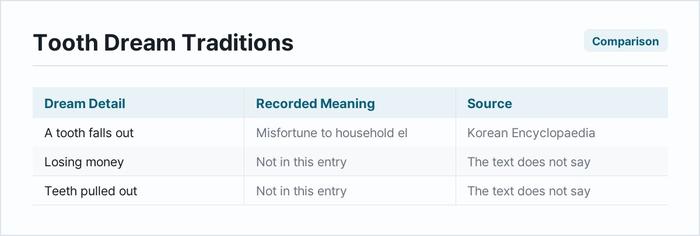
Korean folk interpretation is not a single book. It was handed down orally and varies by region, which is exactly why most articles about it cannot cite anything. There is, however, one standard reference that lists folk dream readings as an encyclopaedia entry, and it does contain a tooth line. In the original Korean it reads “이가 빠지면 → 집안 어른에게 흉한 일이 있다” — If a tooth falls out, it was recorded that misfortune comes to an elder of the household. ([꿈],『한국민족문화대백과사전』)
Two things are worth noticing about that line, because they are the whole value of having a source at all.
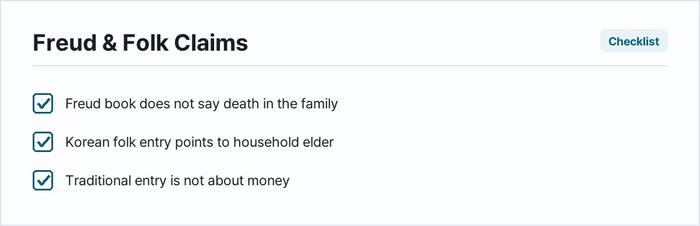
It is not about money. The recorded direction is harm to an elder in the household. The money reading that fills search results is not in this entry.
It is not about the dreamer. The sentence points away from the person dreaming and towards someone older in the same house. Whether you find that comforting or worse is your own business, but it is a different claim from the one usually repeated.
| Dream detail | What is recorded | Source |
|---|---|---|
| A tooth falls out | Misfortune comes to an elder of the household | [꿈],『한국민족문화대백과사전』 |
| How many teeth, which tooth, blood or no blood | Not in this entry | The text does not say |
| Teeth pulled out by someone else | Not in this entry | The text does not say |
| Losing money because of this dream | Not in this entry | The text does not say |
The same encyclopaedia says something about folk dream interpretation as a whole that is easy to skip and worth quoting: the beliefs formed over a long period out of many people's experience, and they do not rest on a settled theory. It also describes two opposite habits of reading a dream — taking the image for what it appears to mean, and reversing it so that a frightening dream is treated as a favourable sign. Both habits are recorded as being in use. That is why two people can hand you opposite answers about the same dream and both be reporting a real tradition.
2. What the psychological text says, and what it does not
The 1913 book is quotable, in the public domain, and specific. In the passage we quote it explains the tooth dream by irritation in the teeth, and it adds a qualification that is usually dropped: the irritation does not have to mean anything is medically wrong. That is the whole of what we take from it.
What follows from that is less exciting than the internet version, and more useful:
- The book treats the dream as having a bodily trigger, not a fixed symbolic meaning.
- It places the dream among recurring types, alongside falling and flying — the kinds of dream that show up in people who have nothing else in common.
- The passage attaches no loss of money, bereavement, betrayal or ageing to this dream. We did not find those attributions anywhere we looked in the text, and we are saying that rather than claiming to have read every page. Where they come from, we could not establish — but they are put in this book's mouth constantly.
We are not going to tell you the book is right. Dream theory from 1913 is not current science, and we are not citing modern research here because we did not verify any. We are telling you what the named text says, so that you can stop being told it says something else.
A checklist you can actually use
If you want this dream to be useful rather than ominous, the useful part is the record you make in the first minute after waking. Dream detail decays fast, and almost all of the questions a tradition would ask are about detail.
- Did the tooth fall out on its own, or was it pulled?
- Was there pain in the dream — and is there any real discomfort in your jaw or teeth today?
- Were you alone, or was someone watching?
- One tooth or several?
- When you woke, was the feeling fear, embarrassment, or relief?
Keep that note. If the dream repeats — and this is one of the dreams people report repeating — you will have something to compare, which is more than any interpretation can give you. The jaw question is there for a plain reason: a text that explains the dream by dental irritation is a text suggesting you check your mouth, not your horoscope.
3. The claims we could not source
This is the section most dream articles do not have, and it is the reason this one is shorter on answers than the pages above it in search results.
| Claim you will see everywhere | What we found |
|---|---|
| “Losing a tooth means losing money” | Not in the encyclopaedia entry. Not in the 1913 text. We could not source it |
| “Freud said it means a death in the family” | The passage on this dream explains it by dental irritation. We found no passage saying this |
| “The number of teeth tells you how many people” | We could not source it in either text |
| A reading for teeth dreams in other traditions | Not verified. We did not check other dream books, so we are not describing them |
“We could not source it” is not the same as “it is false.” Oral tradition genuinely exists outside printed sources, and a reading can be widespread without being written down anywhere we can cite. The honest position is the one above: here is what is written, here is who wrote it, and here is the part nobody can show you.
Related dreams that are not this dream
These get folded together in search results and they are not the same dream, so they are not answered here.
- Teeth crumbling or breaking rather than falling out. Different image, and the entry above does not cover it.
- Falling dreams and flying dreams, which the 1913 book lists beside the tooth dream as recurring types — each handled on its own page, with the same three columns.
- A snake entering the house, which the 1913 book does not treat at all: the word does not appear in it.
- Spitting out teeth, or holding a tooth in your hand. Also not in the entry.
- Being seen undressed, the fourth dream in that list. The book notes a version where the dreamer feels no embarrassment at all, which is a detail worth its own discussion.
So was it a bad dream?
The recorded line points at harm to an elder of the household, which is not a cheerful sentence. But the thing to hold onto is that this is a record of what people believed, written down in an encyclopaedia, not a forecast. The same source says these beliefs grew out of accumulated experience and rest on no settled theory, and that some readings were deliberately reversed. The 1913 passage, meanwhile, points at your jaw.
If you woke up frightened, the two concrete things available to you are both small: write the detail down while you still have it, and if there is any real ache in your teeth, that is worth a dentist rather than a dream dictionary.
Sources: where these readings are documented
Sources checked as of 2026-10-07. Both texts were read directly; neither passage is quoted from a secondary article.
- Korean folk reading — [꿈],『한국민족문화대백과사전』 (The Encyclopedia of Korean Culture, Academy of Korean Studies). The tooth line quoted above is from the dream entry. The entry is a public work that may be used freely with the citation form shown. The English rendering above is ours; the Korean original is given alongside it so you can compare.
- Psychological text — Freud, The Interpretation of Dreams (Brill trans., 1913). Public domain; the two passages quoted are quoted in full as they appear. We quote only those two passages and do not characterise the rest of the book.
- Not used: a second Korean folk encyclopaedia that covers dream readings in more detail. Its licence permits non-commercial use only, and this site carries advertising, so we did not draw on it. You can read it yourself if you want more folk variants.
- No statistics appear in this article. Dream pages that give you percentages are not measuring anything.
Editor's note
Checked: both quoted passages were read in the source texts, not taken from a secondary article. We describe those passages only — we are not summarising the book, and parts of it are deliberately not drawn on here. The Korean line appears above in the original alongside our English rendering.
Not established: which reading, if any, is correct. Folk interpretation has no standard text and varies by region, and the 1913 text is a historical document rather than current science.
Deliberately absent: the money reading, the bereavement reading, and the tooth-counting reading. We looked for sources for all three and did not find them. If you have one, we would rather add it than leave the gap.
Frequently Asked Questions
Did Freud say dreaming your teeth fall out means someone will die?
No. The 1913 Brill translation of The Interpretation of Dreams explains the dream of teeth falling out by irritation in the teeth, and adds that this does not necessarily mean anything is medically wrong. We found no passage attaching bereavement to it — that is what we checked and what we are claiming, rather than a summary of the whole book. The attribution appears to be added by later writers.
Is there any documented traditional meaning for this dream?
Yes, one. The dream entry of The Encyclopedia of Korean Culture records that if a tooth falls out, misfortune comes to an elder of the household ([꿈],『한국및족문화대백과사전』). It is a record of a belief, not a forecast, and the same entry says these beliefs rest on no settled theory.
Does it matter how many teeth fell out, or whether there was blood?
Those details are not covered by the entry quoted here, so we do not give readings for them. They are worth writing down anyway: if the dream repeats, your own notes are the only thing you can actually compare.
Where does the “losing a tooth means losing money” idea come from?
We could not source it. It is not in the encyclopaedia entry and not in the 1913 text. That does not prove it is false — oral tradition exists outside printed sources — but nobody we could find shows where it is written down.
Should I see a dentist because of a dream?
Only if you have a real symptom. The point of the 1913 passage is that this dream was explained by sensation in the mouth, so if you woke with an ache or sensitivity, that is worth a dentist. A dream on its own is not a diagnosis.