Updated: August 25, 2026
Twice-yearly lenacapavir is now a real HIV-prevention option—not an experimental “HIV vaccine.” In the United States, it is approved as Yeztugo for people weighing at least 35 kg who could benefit from pre-exposure prophylaxis (PrEP). Its biggest advantage is practical: two injection visits a year can replace the burden of remembering a pill every day. But the shot still requires HIV testing, on-time follow-up, and a plan if treatment is delayed or stopped.
| At a glance | Answer |
|---|---|
| Purpose | Pre-exposure prophylaxis against sexually acquired HIV-1 |
| Schedule | Subcutaneous maintenance injections every 26 weeks |
| Who | Eligible adults and adolescents weighing at least 35 kg |
| Still required | HIV testing, timely follow-up, and clinician supervision |
What is lenacapavir PrEP?
Lenacapavir is a long-acting capsid inhibitor. The HIV capsid is the protein shell that protects the virus’s genetic material. By interfering with this structure at several points in the viral life cycle, lenacapavir makes it much harder for HIV to establish infection.
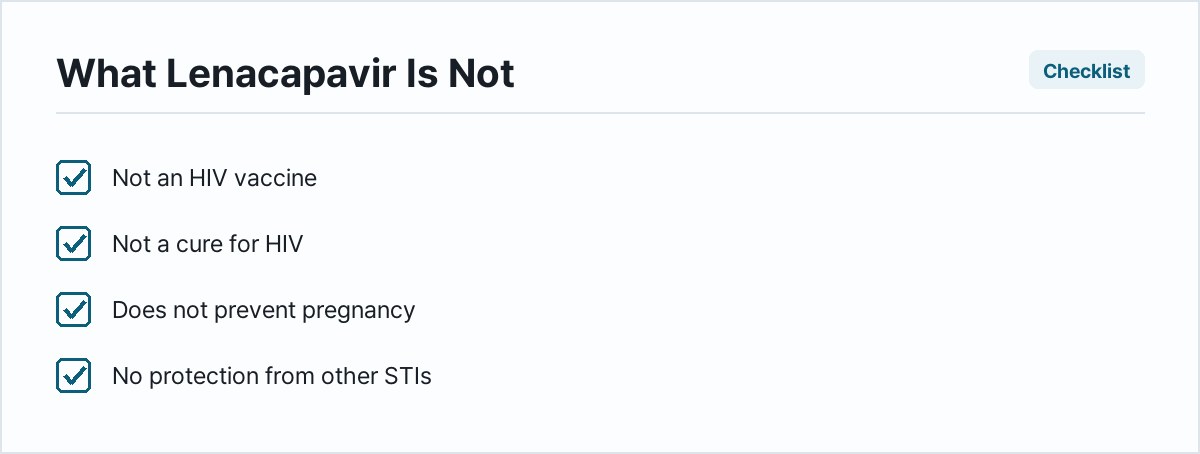
For prevention, the medicine is given as subcutaneous injections every 26 weeks after an initial loading regimen. It does not treat other sexually transmitted infections, prevent pregnancy, cure HIV, or work as a vaccine that trains the immune system. It is prescription PrEP: medicine taken by an HIV-negative person before exposure to reduce the chance of acquiring HIV.
| It is | It is not |
|---|---|
| A long-acting capsid inhibitor | An HIV vaccine |
| PrEP for eligible HIV-negative people | A cure for HIV |
| One additional prevention option | Protection from other STIs or pregnancy |
How effective was it in the major trials?
The evidence comes mainly from two large Phase 3 studies funded by Gilead Sciences.
- PURPOSE 1: Among cisgender women receiving twice-yearly lenacapavir, no HIV infections occurred during the primary analysis. The study was conducted in South Africa and Uganda.
- PURPOSE 2: Among 2,183 participants assigned to lenacapavir in the modified intention-to-treat analysis, two HIV infections occurred. The incidence was significantly lower than both estimated background incidence and the incidence in the daily oral F/TDF comparison group.
These results supported U.S. approval in June 2025. The CDC subsequently issued a strong recommendation, based on high-certainty evidence, for lenacapavir every six months as a PrEP option for people weighing at least 35 kg who would benefit from PrEP. The World Health Organization also recommended twice-yearly injectable lenacapavir as an additional global PrEP option.
The careful interpretation is “very high protection when the regimen and testing schedule are followed,” not “absolute immunity.” Trial performance does not remove the need for repeat HIV testing or timely doses.
| Trial | Population | Observed primary-analysis result |
|---|---|---|
| PURPOSE 1 | Cisgender women in South Africa and Uganda | No HIV infections among lenacapavir recipients |
| PURPOSE 2 | Cisgender men and gender-diverse participants | 2 infections among 2,183 lenacapavir participants in the modified intention-to-treat analysis |
Lenacapavir injection vs. a daily PrEP pill
| Question | Twice-yearly lenacapavir | Daily oral PrEP |
|---|---|---|
| How often? | Injection visit every 26 weeks after initiation | Tablet taken on the prescribed schedule |
| Main practical benefit | Less frequent dosing and greater privacy | No long-acting injection; widely familiar and available |
| Main adherence risk | Missing a scheduled injection or follow-up testing | Forgetting pills or stopping them |
| Common trade-off | Injection-site reactions and clinic administration | Daily routine and regimen-specific monitoring |
| After stopping | Long drug “tail” requires a prevention plan | Protection falls after medication is stopped |
There is no universally best PrEP format. The better option is the one a person can access, tolerate, and follow reliably with a clinician. Someone who dislikes injections or wants direct control over dosing may prefer tablets. Someone who struggles with daily pills, privacy, or stigma may find a twice-yearly injection easier to sustain.
Why HIV testing is essential
A negative HIV test is required before starting lenacapavir PrEP. CDC guidance calls for a blood-based antigen/antibody test within seven days before the first dose and additional testing when clinically indicated. Testing continues at follow-up injection visits.
This is not paperwork. PrEP drugs are not a complete HIV-treatment regimen. If a person already has HIV and receives lenacapavir alone, the virus could develop resistance, making future treatment more complicated. Anyone with possible symptoms of acute HIV infection or a very recent exposure should tell the clinician so the correct testing strategy can be used.
| Checkpoint | Why it matters |
|---|---|
| Before the first dose | Confirm HIV-negative status and assess possible acute infection |
| At follow-up injections | Repeat testing and confirm the prevention plan |
| After a recent exposure or symptoms | Use the appropriate testing strategy before proceeding |
| When stopping | Plan alternative protection during the drug tail |
What happens if an injection is late?
The six-month schedule matters. CDC guidance describes weekly oral lenacapavir as a temporary bridge when a maintenance injection is expected to be at least 14 days late, but that plan must be prescribed and supervised. Another PrEP option may be needed if bridging is not feasible.
Stopping also requires planning. After the protection window ends, small amounts of lenacapavir can remain in the body for many months—the “pharmacologic tail.” Drug levels may be too low to prevent HIV but still high enough to select for resistance if infection occurs. CDC advises assessing ongoing HIV risk and arranging another prevention method when lenacapavir is discontinued.
| Timing problem | Typical clinical response described by CDC |
|---|---|
| Injection expected to be at least 14 days late | Consider prescribed weekly oral lenacapavir bridging |
| Oral bridging is not feasible | Use another suitable PrEP option |
| Lenacapavir is discontinued | Assess ongoing risk and arrange alternative prevention |
Side effects and drug interactions
Injection-site reactions were the most common adverse events in the trials. These were usually mild to moderate, although a small percentage of participants discontinued because of them. A prescriber must also review other medicines and supplements because strong inducers of certain drug-processing pathways can substantially reduce lenacapavir levels.
This article cannot determine whether the medicine is safe for a specific person. Medical history, current medication, possible recent exposure, pregnancy considerations, and local approval or coverage all affect the decision.
| Review area | Question for the clinician |
|---|---|
| Injection reactions | What should I expect and when should I seek care? |
| Drug interactions | Could any prescription, over-the-counter medicine, or supplement lower lenacapavir levels? |
| Recent exposure | Do I need additional HIV testing before starting? |
| Pregnancy considerations | What evidence and monitoring apply to my situation? |
The real breakthrough—and the remaining bottleneck
The scientific breakthrough is not simply “two shots instead of 365 pills.” It is the separation of protection from a daily act that can be disrupted by travel, unstable housing, disclosure concerns, stigma, or ordinary forgetfulness. The regimen moves the hardest adherence decision from every morning to two planned clinical encounters.
That advantage also reveals the new bottleneck: the health system must deliver testing, appointments, medicine, and follow-up on time. A long-acting drug cannot solve a missed clinic visit, an unaffordable bill, a supply shortage, or unequal global access by itself. WHO’s recommendation and access agreements covering lower-income countries are important, but approval, procurement, trained providers, and reliable delivery still vary by country.
| Scientific capability | Real-world dependency |
|---|---|
| Six months of drug exposure | Reliable appointment and supply systems |
| Very high trial efficacy | Correct testing and on-time dosing |
| Discreet long-acting format | Affordable local access |
| Global recommendation | Country approval, procurement, and trained providers |
Questions to ask a PrEP provider
- Which PrEP options are approved and available where I live?
- Which HIV tests do I need before the first dose?
- Could any of my medicines or supplements interact with lenacapavir?
- What should I do if my next injection will be late?
- What prevention plan will I use if I stop?
- What will insurance, a public program, or self-pay actually cover?
| Decision factor | Daily oral PrEP may fit better when… | Lenacapavir may fit better when… |
|---|---|---|
| Dosing preference | You prefer a tablet and direct control | Daily pills are hard to sustain |
| Clinic access | Injection visits are difficult | Two planned visits are manageable |
| Privacy | Medication storage is not a concern | A discreet long-acting option is valuable |
| Flexibility | You may want to stop or switch quickly | You accept the long drug tail and follow-up plan |
| Common claim | Accurate correction |
|---|---|
| “It is an HIV vaccine.” | No. It is a long-acting antiretroviral used as PrEP. |
| “Two shots guarantee immunity.” | No. Protection is very high, but testing and schedule adherence remain essential. |
| “It prevents every STI.” | No. Its indication is HIV prevention. |
| “Nothing is needed after stopping.” | No. The pharmacologic tail requires an alternative prevention plan when risk continues. |
Bottom line
Twice-yearly lenacapavir is one of the most consequential advances in HIV prevention in years because it turns daily adherence into a twice-yearly clinical routine. The trial results were exceptionally strong, and major public-health agencies now recommend it as an additional PrEP option. It is not a vaccine, not a cure, and not maintenance-free. Its success depends on correct HIV testing, on-time dosing, resistance-aware planning, and real-world access.
Primary sources
- CDC: Clinical Recommendation for Injectable Lenacapavir as HIV PrEP
- WHO: Recommendation for twice-yearly injectable lenacapavir
- NEJM: PURPOSE 1 trial
- NEJM: PURPOSE 2 trial
Educational information only. It is not a diagnosis or individualized medical advice.
Disclaimer
This article is general information, not medical advice. It cannot account for an individual's history, medications or risk factors. Anyone weighing a treatment, a test or a change in medication should speak with a qualified healthcare professional first, and treat urgent symptoms as an emergency rather than a research question.