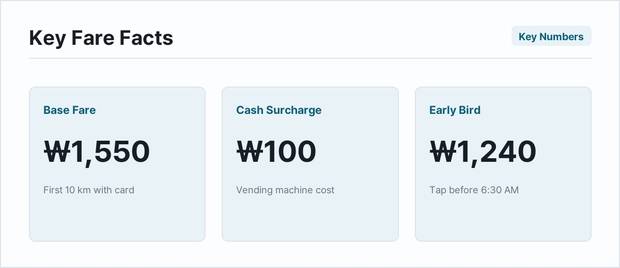
According to the Seoul Metropolitan Government's subway fare table (as of June 28, 2025), a single adult tap on the Seoul subway costs ₩1,550 with a transit card. Paying cash for a single-ride ticket costs ₩1,650 — the city's own page explains the difference as the cost of the vending-machine transaction, not a penalty. Tap before 6:30 AM and the first ride is ₩1,240.
Those three numbers come from one table on the Seoul Metropolitan Government's English transport page, and that table carries its own date: as of 28 June 2025. This matters more than it sounds, because the same page carries two other tables with different dates, and most guides copy all three as though they were one set of 2026 prices. We will keep them apart and tell you which is which.
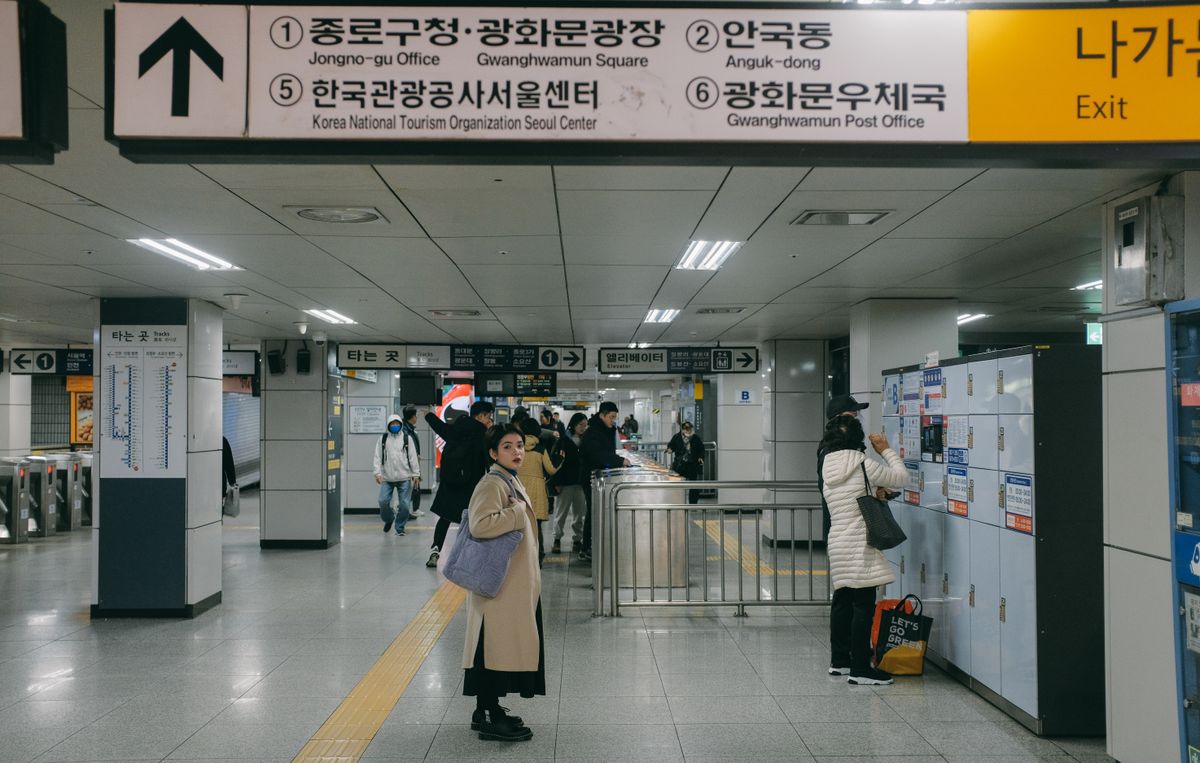
What one ride costs
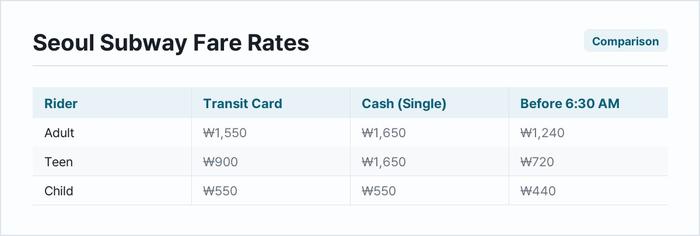
Source: Seoul Metropolitan Government subway fare table (as of June 28, 2025), as cited in this article.
Seoul Metropolitan Government, subway fares as of June 28, 2025:
| Rider | Transit card | Cash, single ride | Before 6:30 AM, card |
|---|---|---|---|
| Adult | ₩1,550 | ₩1,650 | ₩1,240 |
| Teen | ₩900 | ₩1,650 | ₩720 |
| Child | ₩550 | ₩550 | ₩440 |
Three things in that table are easy to miss.
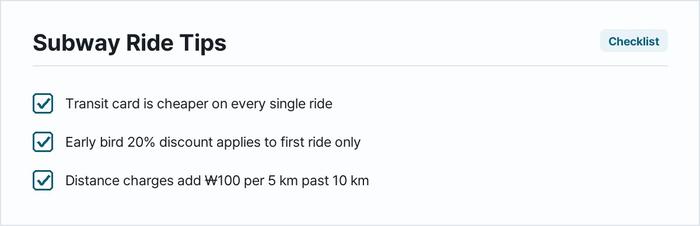
Cash costs ₩100 more, and the reason is mechanical. The page states the single-ride fare is ₩100 higher than the transit-card fare because of the cash transaction at the vending machine. So the card is cheaper on every single ride, before any transfer benefit.
The teen cash fare is the adult cash fare. On the Seoul Metropolitan Government table (as of June 28, 2025), a teenager tapping a card pays ₩900. The same teenager buying a single-ride ticket pays ₩1,650 — the adult price. The discount lives in the card, not in the person.
The early-morning discount on the Seoul Metropolitan Government page (as of June 28, 2025) is 20% off, and only the first ride. The page says it applies to the first ride before 6:30 AM when using a card. It is not an all-day morning rate.
What a longer ride costs
Source: Seoul Metropolitan Government subway fare table (as of June 28, 2025), as cited in this article.
The fares above are base fares, which cover the first 10 km. Beyond that the page gives a simple rule: an additional ₩100 per 5 km once total distance passes the 10 km base range.
That rule is worth more than a distance table, because it lets you estimate any trip. Using the Seoul Metropolitan Government distance rule (as of June 28, 2025), a 25 km ride is 15 km past the base, which is three 5 km blocks, so roughly ₩300 over the base fare. You will not be far off.
Three trips, worked out
Source: Seoul Metropolitan Government subway fare table (as of June 28, 2025), as cited in this article.
The Seoul Metropolitan Government rule (as of June 28, 2025) is ₩100 per 5 km past the first 10 km, so you can price any trip in your head. These are arithmetic from the published rule, not quoted prices — the city publishes the rule, and this is what it gives you.
| Trip | Roughly | How it works out |
|---|---|---|
| A short hop inside the centre | Under 10 km | Base fare only — ₩1,550 with a card |
| Across the city, about 25 km | 15 km past the base | Three 5 km blocks, so about ₩300 over base |
| Out to a satellite city, about 40 km | 30 km past the base | Six 5 km blocks, so about ₩600 over base |
Two cautions on that table. The blocks are counted on total distance for the whole journey, not per leg, which is why a transferred trip can cost more than either leg alone would suggest. And the page states the distance charge applies past the 10 km base range — it does not publish a per-station table, so treat the figures above as estimates built from the rule rather than fares you can quote back at a gate.
Transfers: the part that changes the arithmetic
This is where Seoul differs from most systems, and where a visitor loses money without noticing.
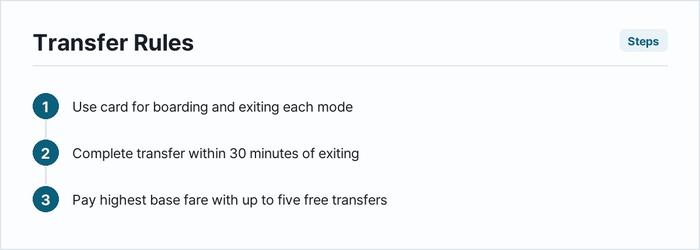
| Rule | What the page states |
|---|---|
| What you are charged | The highest base fare among the modes you used. The bus page states up to four transfers (five boardings); the subway page words it as “up to 5 free transfers” |
| The condition | The integrated fare applies only if you tap your card both when boarding and when getting off each mode |
| The time limit | The transfer must be made within 30 minutes of getting off the previous mode — 60 minutes between 9 PM and 7 AM |
| Distance beyond the base | ₩100 per 5 km once the total distance exceeds the 10 km base range |
| Same bus or route again | Not accepted as a transfer — you pay the base fare again when you re-board the same vehicle or route (bus page) |
| Minimum transfer amount | ₩250 (Seoul Metropolitan Government bus page, fares as of Aug. 12, 2023) |
Read the second row again, because it is the one that costs people money. Tapping out matters. If you leave a bus by the rear door without touching the reader, or walk out of a station gate that you did not tap, the system has no record of where your ride ended, and the integrated fare does not apply. Subway gates make you tap out anyway. Buses are where this goes wrong.
And the allowance is counted across modes, not per mode. Here the two official pages word it differently — the bus page says transfers are accepted up to four times (five boardings) while the subway page says up to five free transfers. We use the bus page's wording because it states the boarding count in brackets. Either way, plan on five rides in one journey, not six. We are not going to tell you one page is wrong; what we checked is that they are worded differently. A bus to a subway to another bus is one journey priced at the highest base fare of the three, as long as every leg is tapped and every gap is inside the time limit.
A short checklist before your first ride
- Buy a transit card rather than single-ride tickets. The card is cheaper on every ride, and single-ride tickets have no transfer benefit to lose.
- Tap on and off. Every mode, every leg.
- If you are changing to a bus, keep the gap under 30 minutes — or under 60 if it is after 9 PM.
- Travelling before 6:30 AM? The first ride is 20% off with a card, per the Seoul Metropolitan Government page (as of June 28, 2025).
- Travelling with a teenager? Make sure they tap a card. A paper ticket charges them the adult fare.
The commuter pass, and why we are flagging its date
The page also lists commuter passes — a 30-day Seoul citywide pass and a ladder of distance-based passes. We are not reproducing those prices here, and the reason is printed on the page itself.
The commuter-pass table is labelled as of 7 October 2023, and immediately after that the page adds a bracketed note: a fare hike was scheduled for 28 June 2025. That is the same date the base-fare table was updated to. In other words, the city updated the fare table and left the pass table on the older date with a note about the increase.
So those pass numbers may be pre-increase figures. We could not confirm the current pass prices from this page, and we are not going to print a number we cannot stand behind. If you are staying long enough for a monthly pass to matter, check the price at a station window or on the operator's Korean page before you buy.
The same caution applies to one more thing on the page: the list of lines and sections where the 15-minute turnstile re-entry rule applies carries its own reference date of 7 October 2023. The rule lets you re-enter through a gate within 15 minutes without paying again on listed sections — useful if you exit the wrong side of a station. Treat the section list as a 2023 snapshot.
What this page does not cover
Source: Seoul Metropolitan Government subway fare table (as of June 28, 2025), as cited in this article.
- Bus fares. A different page, with its own date. The transfer rules above still apply to bus legs.
- Airport trains, limousine buses and taxis. The airport's own pages load their prices in the browser rather than in the page source, so we could not read them. We would rather say that than guess.
- The Climate Card, the unlimited-ride pass, which has its own page and its own break-even arithmetic.
Sources
- Base fares, the ₩100 cash difference, the early-morning discount, the ₩100 per 5 km rule and all four transfer rules — Seoul Metropolitan Government, Subway: https://english.seoul.go.kr/policy/transportation/modes-of-transport/subway/ (fare table as of 28 June 2025).
- Commuter pass table — same page, labelled as of 7 October 2023, with a bracketed note that a fare hike was scheduled for 28 June 2025. Not reproduced here for that reason.
- 15-minute turnstile re-entry sections — same page, reference date 7 October 2023.
Page read and figures taken as of 7 October 2026. Every number above was copied from that table on that day, not from another guide.
Editor's note
Checked: all fares, the transfer conditions and the distance rule were read directly from the official English page, and each figure is reported with the date its own table carries.
Not established: current commuter-pass prices. The page's own note says a hike was scheduled after that table's date, so we left those numbers out rather than print stale ones.
Deliberately absent: airport rail, limousine bus and taxi fares. Those pages build their prices in the browser and we could not read them from the source. No estimates are given.
Frequently Asked Questions
How much is one subway ride in Seoul?
₩1,550 for an adult with a transit card, ₩1,650 for a cash single-ride ticket, and ₩1,240 for the first ride before 6:30 AM with a card. Those are base fares covering the first 10 km; beyond that the city adds ₩100 per 5 km. Fare table as of 28 June 2025, read on 7 October 2026.
Why is cash more expensive than a card?
The city's page states the single-ride fare is ₩100 higher than the transit-card fare because of the cash transaction at the vending machine. It is the cost of the ticket transaction, not a surcharge on you, and it means the card is cheaper on every single ride.
Are transfers really free?
You are charged the highest base fare among the modes you use, and the allowance covers five rides in one journey — the bus page states up to four transfers (five boardings), the subway page words it as up to five free transfers. It applies only if you tap your card both boarding and getting off each mode, and only if each transfer happens within 30 minutes of leaving the previous one (60 minutes between 9 PM and 7 AM). Re-boarding the same bus or route is not a transfer — you pay the base fare again. Forgetting to tap out of a bus is the usual way people lose this.
Is a commuter pass worth it?
We cannot tell you the current price. The pass table on the official page is dated 7 October 2023 and the page itself notes a fare hike was scheduled for 28 June 2025, so those figures may be pre-increase. Check at a station window before buying. We are not printing a number we could not confirm.
Can I re-enter a station if I exited by mistake?
On listed sections, yes — the page describes a 15-minute turnstile re-entry rule. The list of lines and sections carries a reference date of 7 October 2023, so treat it as a snapshot from that year rather than a guarantee for today.