If you are landing in Seoul and you only read one thing about transport, read this: buy a T-money card, put money on it, and tap it on everything. That covers the subway, city buses, and most taxis. The card costs less than a single ride.
What follows is the detail — what the card costs, what each ride costs, and the one condition that catches most visitors on day one. Every figure below is quoted from an official Korean source with the date that source states, because transit fares in Korea change and most English guides are running on numbers that are two increases old.
The short version
| What | How much | Where the figure comes from |
|---|---|---|
| T-money card itself | 3,000–5,000 won (general card) | Korea Tourism Organization, page updated August 2026 |
| Seoul subway, one ride | 1,550 won with a card | Seoul Metropolitan Government, as of 28 June 2025 |
| Seoul city bus (trunk/branch), one ride | 1,500 won with a card | Seoul Metropolitan Government, as of 12 August 2023 |
| Top-up ceiling on the card | 500,000 won | Korea Tourism Organization, August 2026 |
| Climate Card, 30 days unlimited | 62,000 won (transit only) | Seoul Metropolitan Government, as of September 2025 |
One note before the detail, because it will save you confusion: some official English pages still show older fares. Seoul's own overview page for transport lists the subway at 1,400 won and the trunk bus at 1,200 won, while the city's dedicated subway and bus pages — on the same site — list 1,550 and 1,500. Where they disagree, the dedicated pages are the current ones. This guide uses those.
What a T-money card is
T-money is a rechargeable contactless card. You load cash onto it and tap it on a reader when you board and again when you get off. It is not a credit card, not tied to your name, and needs no registration, which is why it suits a short visit.
Where to buy it: convenience stores nationwide — GS25, CU, 7-ELEVEN and others — and the information centres inside Seoul subway stations on Lines 1 to 8.
What it costs: 3,000 to 5,000 won for a general card, depending on which design you pick. That price buys the card. It is not a deposit held against your balance — the money you load is separate.
A practical consequence of buying at a convenience store: the staff will usually ask how much you want to load at the same time. You can say any amount; there is no minimum beyond the price of a ride.
Topping up
You add money at the ticket vending machines inside subway stations, and at the convenience stores that sell the cards. The machines have an English option.
The ceiling is 500,000 won on the card at any one time. That is far more than a normal trip needs, and it matters mainly in the other direction: do not load a large amount near the end of a stay, because getting it back is more awkward than putting it on (see below).
What a ride actually costs
Subway
Seoul's subway fares, as of 28 June 2025, paying with a transportation card:
| Rider | With a card | Single-journey ticket (cash) |
|---|---|---|
| Adult | 1,550 won | 1,650 won |
| Teenager | 900 won | 1,650 won |
| Child | 550 won | 550 won |
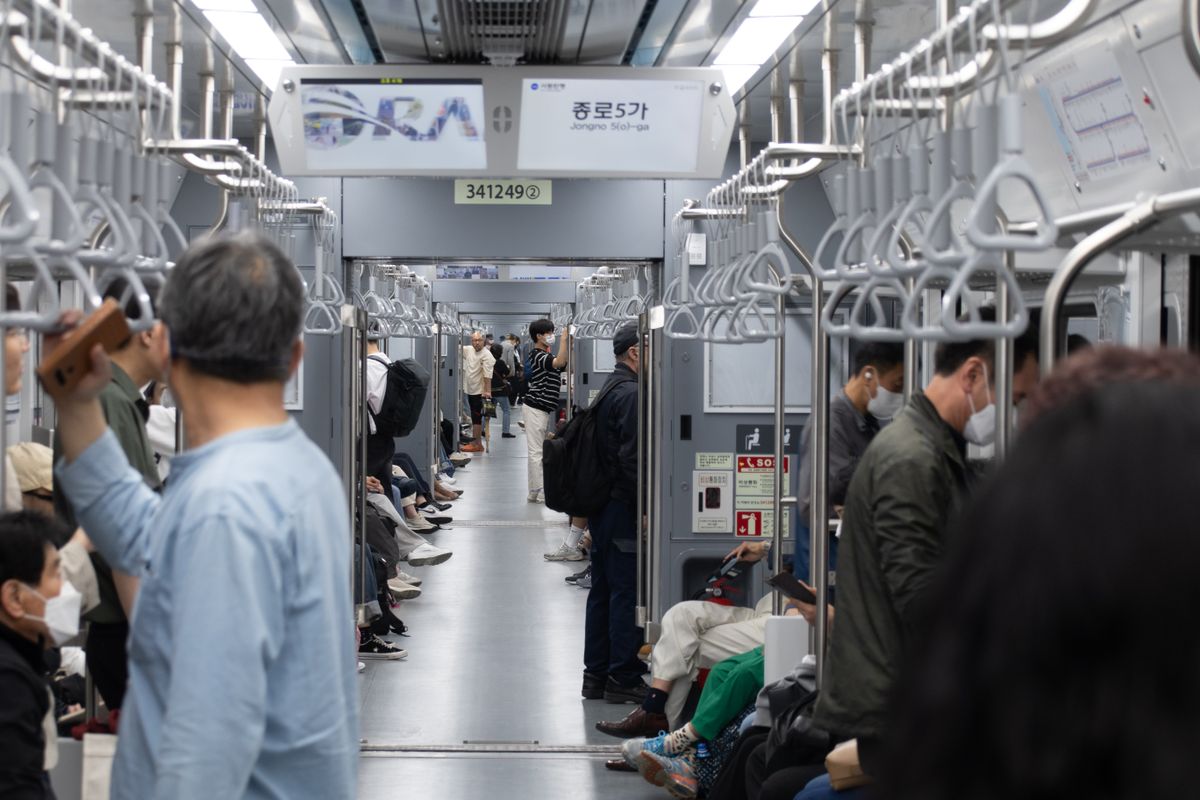
Note the gap between the card fare and the cash fare for adults and teenagers. The card is not a convenience — it is cheaper per ride, every ride.
Distance matters. The fare above covers the first 10 km. Beyond that, the city's stated rule is an additional 100 won per 5 km. A short hop across central Seoul is the base fare; a run out to the edge of the metropolitan area is not.
Buses
Seoul bus fares with a card. The city's bus page states these as of 12 August 2023 — the oldest base date of any figure in this guide, so treat it as the one most likely to have moved. We checked the page in October 2026 and it still showed these numbers; the official page is the place to confirm before you rely on it.
| Bus type | Colour you will see | Adult, with a card |
|---|---|---|
| Trunk / Branch | Blue / Green | 1,500 won |
| Rapid | Red | 3,000 won |
| Circulation | Yellow | 1,400 won |
| Local (village) | Small green | 1,200 won |
| Night ("Owl") | Dark blue, night only | 2,500 won |
The same distance rule applies: base fare up to 10 km, then 100 won for every 5 km.
There is also an early-morning discount — 20% off when you pay with a card before 6:30 AM. If you are heading to an early train or a market, that is worth knowing.
The Climate Card, and when it is actually worth it
Seoul sells an unlimited pass called the Climate Card. The prices, as of September 2025:
| Pass | Price |
|---|---|
| 30 days, transit only | 62,000 won |
| 30 days, with Ttareungi (public bikes) | 65,000 won |
| 30 days, with Hangang Bus | 67,000 won |
| 30 days, with both | 70,000 won |
| 1 day | 5,000 won |
| 2 days | 8,000 won |
| 3 days | 10,000 won |
| 5 days | 15,000 won |
| 7 days | 20,000 won |
A physical card costs 3,000 won on top, bought separately.
You can work out the break-even yourself from the published figures, which is better than trusting a number someone else calculated. At the 1,550 won subway fare, the 62,000 won monthly pass equals roughly 40 rides (62,000 ÷ 1,550 ≈ 40). Two rides a day for twenty days is 40 rides — so a commuter clears it easily, and a visitor doing three or four trips a day for a week does not come close on the monthly pass but might on a short-term one. For the short-term passes, divide the price by 1,550 the same way: the 5,000 won day pass pays off at about four rides.
The short-term passes start on the day you charge the card, not the day you first tap. If you buy a 3-day pass on arrival evening and do not travel until the next morning, you have spent one of the three days.
The airport condition that catches people
This is the part most guides leave out, and it is the single most useful sentence in this article.
The Climate Card does include the AREX airport railroad — and since 13 September 2024 you can get off at Incheon Airport Terminal 1 and Terminal 2. What you cannot do is board the train there. That asymmetry is the whole point: the pass covers the ride out to the airport, but not the ride in from it. You will pay for that leg separately regardless of holding the pass.
Two other coverage limits from the same official page:
- The card covers Seoul-based subway lines plus some Gyeonggi-serviced routes, and Seoul-licensed city and town buses. A bus licensed by a neighbouring city is not automatically included.
- The Shinbundang Line is excluded. If your route depends on it, the pass will not cover that segment.
Before you tap: a short checklist
Other cards you will see
T-money is the default, not the only option.
- EZL (also branded Cashbee) — from 4,000 won, sold at convenience stores nationwide. Refunds of under 20,000 won can be handled at a convenience store.
- WOWPASS — 5,000 won, bought through its app or at kiosks in airports, subway stations and hotels. Its distinguishing feature is that the kiosks accept foreign currency: KRW as well as USD, JPY, CNY and others. If you arrive with cash in your home currency and no Korean bank account, that solves a real problem.
Which card should you buy?
Three cards cover the same transit network, and the differences are about where you buy them and how you get money back rather than about the rides themselves.
| T-money | EZL (Cashbee) | WOWPASS | |
|---|---|---|---|
| Card price | 3,000–5,000 won | From 4,000 won | 5,000 won |
| Where to buy | Convenience stores nationwide; Seoul subway information centres, Lines 1–8 | Convenience stores nationwide | App, or kiosks at airports, subway stations and hotels |
| Loading foreign currency | Not stated | Not stated | Yes — kiosks accept KRW, USD, JPY, CNY and others |
| Getting leftover money back | Over 50,000 won only at T-money Town, Seoul Station | Under 20,000 won at a convenience store | Balance on a lost card can be moved to a new card |
Reading across, the choice is usually straightforward. T-money is the default because it is the easiest to find — every convenience store has it. EZL matters mainly for its refund threshold: small balances are handled at a shop counter rather than at one specific station. WOWPASS solves a narrow but real problem, which is arriving with cash in your own currency and no Korean bank account.
A practical note on refunds that applies to all three: the thresholds run in opposite directions. T-money's rule names the amount *above* which you must travel to one counter; EZL's names the amount *below* which a shop can help. If you expect to have a large balance left, that difference is the one to plan around.
A short checklist before you tap
Why this page shows its dates
Korean transit fares change, and a guide without dates cannot be checked. Every figure above carries the date its source states, which lets you do two things an undated guide does not allow: see at a glance which numbers are most likely to have moved since, and go to the same page and compare.
The bus fares here are the oldest base date in this guide, so they are the ones to confirm first. The subway fare was restated more recently. That is the kind of thing an undated table hides.
Getting your money back
Leftover balance is refundable, with a threshold that is easy to trip over.
Refunds over 50,000 won can only be processed at T-money Town in Seoul Station. Smaller amounts are handled more easily, but if you have loaded a large balance you are committing to a trip to one specific counter in one specific station before you fly out.
The practical rule: load in smaller amounts more often rather than one large amount at the start. The top-up machines are everywhere; the refund counter is not.
What this guide does not tell you
It is worth being explicit about the gaps, because a guide that pretends to be complete is the kind that gets a detail wrong.
- Transfer discounts. Seoul has a free-transfer system between subway and bus, and it is one of the best things about the network. The only official English page we found stating the exact rules is the same overview page that is showing outdated fares, so we are not quoting numbers from it. Until we can cite a current page, this guide says only that transfers are discounted and that you must tap when you get off for the discount to apply.
- The single-journey ticket deposit. Single-journey tickets carry a refundable deposit you reclaim from a machine. We could not load the operator's English fare page to confirm the amount, so we are not stating it.
- Where T-money works outside Seoul. The cards are sold nationwide, which is confirmed. Which cities' buses and subways accept them is a separate question that varies by region, and we have not verified it city by city.
- Whether the card price itself is refundable. The 3,000–5,000 won buys the card rather than acting as a deposit, but we have not found official wording that says so outright, so we are not asserting it either way.
Editor's note
Checked: every figure in this article is quoted from an official Korean government or tourism-authority page, with the date that page states, and the links are below. Where two official pages disagreed, we used the more specific and more recently dated one and said so in the text.
Not established: the four items listed in the section above. They are left blank rather than filled in from secondary sources.
Known staleness risk: the bus fares carry a base date of 12 August 2023 — older than anything else here. Confirm on the official page before relying on them.
Reviewed as of 2026-10-05.
Sources
- Seoul subway fares — Seoul Metropolitan Government, Subway: https://english.seoul.go.kr/policy/transportation/modes-of-transport/subway/ (as of 28 June 2025)
- Seoul bus fares — Seoul Metropolitan Government, Bus: https://english.seoul.go.kr/policy/transportation/modes-of-transport/bus/ (as of 12 August 2023)
- Climate Card prices and coverage — Seoul Metropolitan Government: https://english.seoul.go.kr/policy/transportation/climate-card/ (as of September 2025)
- Transportation card prices, purchase points, top-up ceiling and refunds — Korea Tourism Organization: https://english.visitkorea.or.kr/svc/contents/contentsView.do?vcontsId=140663 (page updated August 2026)
Frequently Asked Questions
Do I need a T-money card, or can I just use my credit card?
A T-money card is the simplest option and costs 3,000 to 5,000 won. The card fare is also lower than the cash single-journey fare on the Seoul subway — 1,550 won against 1,650 won for an adult as of 28 June 2025 — so the card pays for itself quickly if you travel more than a few times.
Does the Climate Card cover the trip from Incheon Airport?
No. Seoul's official page states that since 13 September 2024 you can get off at Terminal 1 and Terminal 2 with the card, but you cannot board the train there. The trip from the airport into the city is paid separately even if you hold the pass.
How many rides does the 62,000 won monthly Climate Card need to pay off?
Dividing the published figures, 62,000 won at the 1,550 won adult subway fare is about 40 rides. Two rides a day for twenty days reaches that, so a daily commuter clears it and a short visit generally does not.
Where do I get my leftover balance back?
Refunds over 50,000 won can only be processed at T-money Town in Seoul Station, according to the Korea Tourism Organization. Smaller amounts are easier, which is why loading smaller amounts more often is the practical approach.
Why do some English guides show different Seoul fares?
Because some official English pages still carry older figures. Seoul's transport overview page lists the subway at 1,400 won and the trunk bus at 1,200 won, while the city's dedicated subway and bus pages list 1,550 and 1,500. Where they disagree, the dedicated pages are current.